
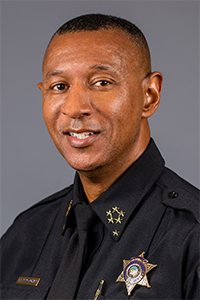
After a long career in law enforcement, including time spent as a police officer in Winston-Salem, and as a special agent for the D.E.A., Bobby Kimbrough could have retired and turned his back on public service. But Bobby isn’t one to rest on his laurels or to sit idly by when presented with a challenge. In 2018 he was persuaded to run for office against a long-time, popular incumbent, and, against all odds, he unseated Bill Schatzman to become the first African American sheriff in the history of Forsyth County. And while most political newcomers are afforded a honeymoon period, Bobby had to confront two pandemics head-on after barely a year on the job. One pandemic was COVID, and the other was racism.
In 2020, COVID-19 swept through the nation, eventually killing over a million of our neighbors and loved ones. That same year, George Floyd, a Black man, died as a result of excessive force by a White Minneapolis police officer. That incident stirred nationwide protests against systemic racism in law enforcement, and an understandable decline in the number of people (especially people of color) applying to work for police and sheriff’s departments. There was also an ill-timed call by some politicians and disenfranchised populations for defunding the police at a time when, ironically, violent crime was on the rise, including in our public schools.
Sheriff Kimbrough and I have had many conversations over the past six years, during which time a host of other public safety issues has arisen, ranging from an increase in gang activity, to the way in which violent juveniles are prosecuted. I thought now would be a good time for review and reflection as he settles in for the last half of his second term in office.
JL: Before becoming Sheriff, you had extensive law enforcement experience on both the local and federal levels, and yet, I’m wondering if anything about your current job surprised you that first year?
BK: Of course. Budgeting and navigating the political landscape were entirely new to me. I learned that there are hundreds of demands placed on the sheriff, many of which have little to do with law enforcement. Also, I had to learn quickly how to adapt while maintaining the level of service necessary to create a top-tier law enforcement agency. More importantly, this position has given new meaning to prayer in my life. It has become a daily necessity.
JL: School shootings are on the rise nationwide. What kinds of security measures should we take to prevent those tragedies from happening?
BK: As it relates to school security and school as a whole, we must first recognize and prioritize what is truly valuable. I will never forget meeting Rabbi Charlie who told me, “A budget is a reflection of what you value.” When it comes to school security and our protective measures, we have not placed enough value and resources on what matters most -our children and their educators. I can’t help but ask, “Why are our courthouses and college basketball games more secure than our schools?” The reason these places remain secure is the resources allocated to ensure safety of those entering and participating in the events there. The key word is “Resources”.
JL: We are starting to see more minors being tried as adults in cases of violent crime. Is that a good idea? and, if so, is it deterring 16 and 17 year-olds from violent behavior, such as assaulting teachers?
BK: While we are charging juveniles with adult crimes, we must remember that we are dealing with undeveloped minds. Time will ultimately reveal whether these decisions were wise or flawed. Once again, resources are critical. If applied effectively on the front end, they can positively impact outcomes on the back end. We must never forget that decisions create conditions.
JL: How prevalent is gang activity in our area, and what resources do you need to combat it?
BK: It’s no secret that gang activity is present in our area. Again, though, resources are the key to solving any problem, but that doesn’t only mean handcuffs or incarceration. Resources include jobs, tutoring, and housing.
JL: Back in 2016 you authored a book titled, Surviving the Stop, which is sort of a primer in how people (especially people of color) can avoid confrontation with police during a traffic stop. Are police and sheriff’s departments making any progress in lessening incidents of excessive force?
BK: Training is essential to advancing any agency. It involves understanding the community that it serves, addressing conflict resolution, and improving practices. Training has always been a priority for us.
JL: Not so long ago, your office had a lot of openings. How have you been doing with recruiting?
BK: You recall several years ago we had 135 vacancies just on the detention side. Today we’re down to only 30. We’re also fully staffed in terms of sworn officers. I have to give a shout out to our County Commissioners and County Manager for raising salaries. The new color of hope is green, and people do these jobs for money.
JL: What are your biggest challenges as Sheriff for 2025 and beyond?
BK: I don’t see challenges, I see opportunities. This includes requesting additional manpower, advocating for increased technology funding, and advancing the premier law enforcement agency in the State.
JL: Following the tragic death of your wife in 2005, you had to raise seven sons by yourself. Have any of them pursued a career in law enforcement?
BK: Yes, Jordan is employed with the Guilford County Sheriff’s office. Christian is currently with the Atlanta Police Department, and Bryce is in the process to become a deputy at a sheriff’s office in California.
JL: What has been gratifying to you about being sheriff?
BK: One of the most gratifying aspects of my role is being able to serve the town where I grew up. It’s an incredible feeling to know that the people have entrusted me with this office and believe in me. The love and support they show me are what drives me, even on the toughest days. I am deeply grateful and thankful.
February 18, 2025 @ 4:08 am
























Catching Up With Sheriff Bobby Kimbrough
After a long career in law enforcement, including time spent as a police officer in Winston-Salem, and as a special agent for the D.E.A., Bobby Kimbrough could have retired and turned his back on public service. But Bobby isn’t one to rest on his laurels or to sit idly by when presented with a challenge. In 2018 he was persuaded to run for office against a long-time, popular incumbent, and, against all odds, he unseated Bill Schatzman to become the first African American sheriff in the history of Forsyth County. And while most political newcomers are afforded a honeymoon period, Bobby had to confront two pandemics head-on after barely a year on the job. One pandemic was COVID, and the other was racism.
In 2020, COVID-19 swept through the nation, eventually killing over a million of our neighbors and loved ones. That same year, George Floyd, a Black man, died as a result of excessive force by a White Minneapolis police officer. That incident stirred nationwide protests against systemic racism in law enforcement, and an understandable decline in the number of people (especially people of color) applying to work for police and sheriff’s departments. There was also an ill-timed call by some politicians and disenfranchised populations for defunding the police at a time when, ironically, violent crime was on the rise, including in our public schools.
Sheriff Kimbrough and I have had many conversations over the past six years, during which time a host of other public safety issues has arisen, ranging from an increase in gang activity, to the way in which violent juveniles are prosecuted. I thought now would be a good time for review and reflection as he settles in for the last half of his second term in office.