There has been much debate lately about when and how federal troops should be deployed to restore order in cities with high crime rates or where violence is out of control. That’s because National Guard units showed up in Washington, D.C. earlier this year, and the administration is looking to do the same in Portland, Chicago, and other cities. That begs the question: Can we envision a time and circumstance when National Guard troops would ever be sent into the Triad? The answer is “yes,” and in fact it has already happened once before. Here’s the background.
On Oct. 15, 1967, James Eller, an African American father of four, was seen staggering across a street. Mr. Eller made it to the front porch of his house, where several police officers caught up with him and proceeded to arrest him for alleged public drunkenness. According to police, Eller resisted arrest, and the officers tried to subdue him, first by spraying MACE into his eyes. That didn’t work, so Patrolman W.E. Owens struck Eller on the head with a blackjack. It proved to be a fatal blow. Police didn’t release details of Eller’s death until eight days later, and it was another four days after that before Owens was suspended. Eller’s widow swore out a warrant against Owens, which, according to the Winston-Salem Journal, stated that Owens, “feloniously, with premeditation, deliberation, and malice a fore thought, did kill and murder one James Eller.” Judge Leroy Sams dismissed the case, and that ruling triggered riots in downtown Winston-Salem.
Winston-Salem Journal and Twin City Sentinel reporters provided extensive coverage of the riots, which included descriptions of damage to stores along Liberty, North Trade, North Cherry, Claremont, Main, and Fourth Streets. Most of the businesses were looted, then burned. Mobs particularly targeted jewelry and liquor stores, as well as furniture and appliance stores. Fires broke out everywhere, cars were overturned, bricks were tossed, and shots were fired.
Patrolman E.W. Thorpe described the Nov. 2 sniper fire to reporter Eugene White, saying, “Guns were reporting everywhere, and you didn’t know who was shooting at who.” Thorpe’s own patrol car was struck by sniper fire at 13th and Patterson Avenues. His partner, C.E. Crosby, who fought in the Pacific during WWII, described the rioting as a “small scale war.” Said Crosby, “We didn’t know where to take cover when there was shooting. We were afraid we might try to take cover where the shooting was coming from.”
Mobs also set a fire just behind a Reynolds Tobacco factory on Chestnut Street. The fire was burning near a gas tank, and had Thorpe and Crosby not arrived in time to put it out, there probably would be no Innovation Quarter today.
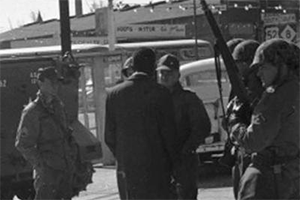
Twin City police chief Cornelius Tucker told his troops to “take things easy on the mob,” but he added, “Pull out the heavy stuff. Don’t use it unless you have to, but display it. But STOP it.” Normally, local National Guardsmen are not called upon to defend their own city, but the 200-man Winston-Salem guard was put on alert. Meanwhile, Mayor M.C. Benton and Governor Dan Moore deployed National Guardsmen from Mount Airy. Most of them patrolled the streets, while others were given rooftop duty. Two of them, Spec 4 Tommy Hennis and PFC Rodney Cooke, were positioned atop the Robert E. Lee Hotel.
I was 13 years old at the time, and I vividly remember riding to church and seeing armed National Guardsmen positioned on tops of buildings throughout downtown Winston-Salem.
After a couple of days, all that remained of the “small scale war” were charred buildings and debris in the streets. Order had been restored without loss of life.
The events of Oct. 15 and Nov. 2, 1967, taught us a lot about race relations, the criminal justice system, mobs, and the way Winston-Salem dealt with all of them. Officer Owens probably didn’t mean to kill Mr. Eller, but his unnecessary use of force triggered a firestorm nevertheless. Critics of the time said the officers on Eller’s front porch that fateful day should have used handcuffs instead of MACE and nightsticks. The police chief should have gone public within hours of Eller’s death. Judge Sams should have meted out an appropriate punishment for Officer Owens. And the rioters should have stayed home because burning and looting is never an appropriate or effective response to police brutality.
The Winston-Salem police did an admirable job during the riots of 1967, but they couldn’t have restored order without help from the National Guard, proving that there are times when a military presence is absolutely necessary.
Of course, such deployment should always be at the behest of the governor, and in this case, his decision proved to be justified. That was nearly 60 years ago, but we must be ever vigilant when it comes to dealing with the things that often divide us. As then Winston-Salem Journal editor Wallace Carroll wrote, “No city in America is immune from the passions of these days.”
























National Guard in the Triad?
There has been much debate lately about when and how federal troops should be deployed to restore order in cities with high crime rates or where violence is out of control. That’s because National Guard units showed up in Washington, D.C. earlier this year, and the administration is looking to do the same in Portland, Chicago, and other cities. That begs the question: Can we envision a time and circumstance when National Guard troops would ever be sent into the Triad? The answer is “yes,” and in fact it has already happened once before. Here’s the background.
On Oct. 15, 1967, James Eller, an African American father of four, was seen staggering across a street. Mr. Eller made it to the front porch of his house, where several police officers caught up with him and proceeded to arrest him for alleged public drunkenness. According to police, Eller resisted arrest, and the officers tried to subdue him, first by spraying MACE into his eyes. That didn’t work, so Patrolman W.E. Owens struck Eller on the head with a blackjack. It proved to be a fatal blow. Police didn’t release details of Eller’s death until eight days later, and it was another four days after that before Owens was suspended. Eller’s widow swore out a warrant against Owens, which, according to the Winston-Salem Journal, stated that Owens, “feloniously, with premeditation, deliberation, and malice a fore thought, did kill and murder one James Eller.” Judge Leroy Sams dismissed the case, and that ruling triggered riots in downtown Winston-Salem.
Winston-Salem Journal and Twin City Sentinel reporters provided extensive coverage of the riots, which included descriptions of damage to stores along Liberty, North Trade, North Cherry, Claremont, Main, and Fourth Streets. Most of the businesses were looted, then burned. Mobs particularly targeted jewelry and liquor stores, as well as furniture and appliance stores. Fires broke out everywhere, cars were overturned, bricks were tossed, and shots were fired.
Patrolman E.W. Thorpe described the Nov. 2 sniper fire to reporter Eugene White, saying, “Guns were reporting everywhere, and you didn’t know who was shooting at who.” Thorpe’s own patrol car was struck by sniper fire at 13th and Patterson Avenues. His partner, C.E. Crosby, who fought in the Pacific during WWII, described the rioting as a “small scale war.” Said Crosby, “We didn’t know where to take cover when there was shooting. We were afraid we might try to take cover where the shooting was coming from.”
Mobs also set a fire just behind a Reynolds Tobacco factory on Chestnut Street. The fire was burning near a gas tank, and had Thorpe and Crosby not arrived in time to put it out, there probably would be no Innovation Quarter today.
Twin City police chief Cornelius Tucker told his troops to “take things easy on the mob,” but he added, “Pull out the heavy stuff. Don’t use it unless you have to, but display it. But STOP it.” Normally, local National Guardsmen are not called upon to defend their own city, but the 200-man Winston-Salem guard was put on alert. Meanwhile, Mayor M.C. Benton and Governor Dan Moore deployed National Guardsmen from Mount Airy. Most of them patrolled the streets, while others were given rooftop duty. Two of them, Spec 4 Tommy Hennis and PFC Rodney Cooke, were positioned atop the Robert E. Lee Hotel.
I was 13 years old at the time, and I vividly remember riding to church and seeing armed National Guardsmen positioned on tops of buildings throughout downtown Winston-Salem.
After a couple of days, all that remained of the “small scale war” were charred buildings and debris in the streets. Order had been restored without loss of life.
The events of Oct. 15 and Nov. 2, 1967, taught us a lot about race relations, the criminal justice system, mobs, and the way Winston-Salem dealt with all of them. Officer Owens probably didn’t mean to kill Mr. Eller, but his unnecessary use of force triggered a firestorm nevertheless. Critics of the time said the officers on Eller’s front porch that fateful day should have used handcuffs instead of MACE and nightsticks. The police chief should have gone public within hours of Eller’s death. Judge Sams should have meted out an appropriate punishment for Officer Owens. And the rioters should have stayed home because burning and looting is never an appropriate or effective response to police brutality.
The Winston-Salem police did an admirable job during the riots of 1967, but they couldn’t have restored order without help from the National Guard, proving that there are times when a military presence is absolutely necessary.
Of course, such deployment should always be at the behest of the governor, and in this case, his decision proved to be justified. That was nearly 60 years ago, but we must be ever vigilant when it comes to dealing with the things that often divide us. As then Winston-Salem Journal editor Wallace Carroll wrote, “No city in America is immune from the passions of these days.”