
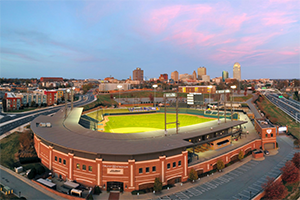
In the summer of 1970, I was the public address announcer for Ernie Shore Field. It was a dream job for a high school kid who loved baseball because I got to be around and get to know all of the players on what was then the Winston-Salem Red Sox. That year the Sox won the Carolina League championship, and during every home game, I occupied a seat in the press box next to the legendary sports journalist Frank Spencer. Actually, it wasn’t much of a press box. What it was, was a small, rickety wooden shack that sat atop the stadium, and legend has it that sometime after my tenure, a strong wind blew the shack off its perch, and onto the ground below. Years later the Sox became the DASH and moved into a new stadium overlooking I-40. Ernie Shore Field, meanwhile, was renovated and became the home of Wake Forest University baseball. I mention all of this because I know a little something about why stadiums sometimes need to be upgraded, and because last week we learned that Major League Baseball (MLB) gave the DASH an ultimatum: either spend $5 million dollars to renovate Truist Field or else lose the franchise.
Keep in mind that, unlike Ernie Shore Field, which was built in the dark ages, the new DASH stadium didn’t open until 2010, so there’s no rickety press shack to replace. In fact, the twelve-year-old facility is in great shape, but MLB likes to throw its weight around these days, and given the number of minor league teams it has already closed down, the City of Winston-Salem has no choice but to comply.
So exactly what improvements is MLB demanding to be made? For one, the league wants clubhouse areas to be renovated for both home and visiting teams. The Winston-Salem Journal also reports that MLB wants improvements made to laundry and commissary areas, plus private locker rooms for female staff, coaches and umpires. They also want a second hitting and pitching tunnel that is protected from the elements, along with changes to the field, including adjusting the bullpen mounds, and a higher wall in the right field corner. No doubt the improvements will be a welcome sight to players and coaches, and they will increase the value of the stadium. But the improvements are not essential, nor will they enhance the fan experience. Speaking of fans, they’re the ones paying for the renovation, and that leads me to an insulting sticking point about this saga.
The $5 million dollars worth of upgrades to Truist stadium are being paid for through limited obligation bonds, which means the expenditure doesn’t have to be approved by voters. So much for democracy and transparency. And this isn’t the first time local taxpayers have been railroaded because of the same baseball park. Years ago, residents got stuck with paying $48 million dollars for construction of the stadium after private developers walked away from the project before it was completed. In a perfect world, the DASH stadium should have been built with private money, as was the beautiful Greensboro Grasshopper’s facility. In a perfect world, residents of Winston-Salem should have had a say about cost overruns and projected renovations from the get-go. But we don’t live in a perfect world. We live in a world where a greedy baseball league can bully, threaten, and extort our elected officials, and where residents have to pony up another cut of their meager wages, or else face having to maintain a vacated facility.
Fifty-two years ago, Winston-Salem’s minor league baseball team played in a well-worn stadium with smelly old locker rooms and no fancy area for pitchers to warm up in. And 52 years ago, I announced the proceedings from inside a rickety wooden press shack that teetered high atop the stands. Yet somehow a record number of fans attended our games, and the team brought home a championship trophy. Major League Baseball didn’t threaten us back then, and nobody worried about obligation bonds. Now as then, baseball owners depend upon cities like Winston-Salem to nurture future stars that will help keep big league coffers overflowing. In that sense, we’re more important to their bottom line than they are to ours. It’s something to think about the next time we receive an ultimatum from a bunch of rich guys.
August 23, 2022 @ 5:58 am
























MLB Commits an Error
In the summer of 1970, I was the public address announcer for Ernie Shore Field. It was a dream job for a high school kid who loved baseball because I got to be around and get to know all of the players on what was then the Winston-Salem Red Sox. That year the Sox won the Carolina League championship, and during every home game, I occupied a seat in the press box next to the legendary sports journalist Frank Spencer. Actually, it wasn’t much of a press box. What it was, was a small, rickety wooden shack that sat atop the stadium, and legend has it that sometime after my tenure, a strong wind blew the shack off its perch, and onto the ground below. Years later the Sox became the DASH and moved into a new stadium overlooking I-40. Ernie Shore Field, meanwhile, was renovated and became the home of Wake Forest University baseball. I mention all of this because I know a little something about why stadiums sometimes need to be upgraded, and because last week we learned that Major League Baseball (MLB) gave the DASH an ultimatum: either spend $5 million dollars to renovate Truist Field or else lose the franchise.
Keep in mind that, unlike Ernie Shore Field, which was built in the dark ages, the new DASH stadium didn’t open until 2010, so there’s no rickety press shack to replace. In fact, the twelve-year-old facility is in great shape, but MLB likes to throw its weight around these days, and given the number of minor league teams it has already closed down, the City of Winston-Salem has no choice but to comply.
So exactly what improvements is MLB demanding to be made? For one, the league wants clubhouse areas to be renovated for both home and visiting teams. The Winston-Salem Journal also reports that MLB wants improvements made to laundry and commissary areas, plus private locker rooms for female staff, coaches and umpires. They also want a second hitting and pitching tunnel that is protected from the elements, along with changes to the field, including adjusting the bullpen mounds, and a higher wall in the right field corner. No doubt the improvements will be a welcome sight to players and coaches, and they will increase the value of the stadium. But the improvements are not essential, nor will they enhance the fan experience. Speaking of fans, they’re the ones paying for the renovation, and that leads me to an insulting sticking point about this saga.
The $5 million dollars worth of upgrades to Truist stadium are being paid for through limited obligation bonds, which means the expenditure doesn’t have to be approved by voters. So much for democracy and transparency. And this isn’t the first time local taxpayers have been railroaded because of the same baseball park. Years ago, residents got stuck with paying $48 million dollars for construction of the stadium after private developers walked away from the project before it was completed. In a perfect world, the DASH stadium should have been built with private money, as was the beautiful Greensboro Grasshopper’s facility. In a perfect world, residents of Winston-Salem should have had a say about cost overruns and projected renovations from the get-go. But we don’t live in a perfect world. We live in a world where a greedy baseball league can bully, threaten, and extort our elected officials, and where residents have to pony up another cut of their meager wages, or else face having to maintain a vacated facility.
Fifty-two years ago, Winston-Salem’s minor league baseball team played in a well-worn stadium with smelly old locker rooms and no fancy area for pitchers to warm up in. And 52 years ago, I announced the proceedings from inside a rickety wooden press shack that teetered high atop the stands. Yet somehow a record number of fans attended our games, and the team brought home a championship trophy. Major League Baseball didn’t threaten us back then, and nobody worried about obligation bonds. Now as then, baseball owners depend upon cities like Winston-Salem to nurture future stars that will help keep big league coffers overflowing. In that sense, we’re more important to their bottom line than they are to ours. It’s something to think about the next time we receive an ultimatum from a bunch of rich guys.