Commentaries Archive


Remembering Clu Gulager: Real Cowboy, Real Artist

Posted August 16, 2022 By Triad Today
Actor Clu Gulager

Clu Gulager, right, with Jim Longworth

Acting can be dangerous. Just ask Clu Gulager:

“I played the Mouse King in third grade, and this girl named Marian Bebb threw a shoe at me and killed me.”

It’s no wonder young Clu put his acting career on hold for a while. Who wouldn’t, after being killed by a flying shoe? Still, the work he did during his formative years was no picnic either, but at least it prepared him for some of the roles he would play later on.

“I was a cowboy in Oklahoma, where we raised white-face cattle. I used to have to ride the fences, and in winter it was really cold. When I saw a break in the fence, I had to get down off of my pony with some wire and fix that break. The thing I’m most proud of in my whole life is that, on my watch, not one white face got away.”

And while Clu spent most of his time doing cowboy chores, he was also influenced by his father’s many talents as a cowboy performer in Vaudeville and on Broadway. The elder Gulager was particularly known for his mastery of rope tricks, something he had in common with a famous relative.

“My father grew up in Indian Territory with his cousin Will Rogers. They were both very adept at trick roping. According to my aunt, Will would spend hours and hours down by the barn practicing with the ropes. He always wanted to improve. But my uncle once told me, ‘Your Dad was better than Will at twirling ropes!’”

Inspired by his father’s showmanship, and armed with a fierce work ethic, Clu struck out on his own, and paid his dues as a thespian by appearing on stage, as well as in a number of live television dramas. He soon signed as a contract player with Universal Studios where he appeared in everything from mystery series to crime shows. But the Oklahoma ranch hand also found himself working on TV westerns, which led to his being offered the starring role of Billy the Kid on NBC’s The Tall Man.  

“My agent and I sat in the car for about three hours deciding whether or not to wait for movies, or take The Tall Man series. I had a wife and little boy to support, so I took the TV show, and I’ve never regretted it.”

But Gulager, who studied the Stanislavski Method, was as serious about his acting as he had been about his ranching, and the shooting schedule of make-believe westerns was frustrating to the young star.

“Artists pride ourselves on taking our time to find things in the words. But that didn’t happen on TV. The networks wanted those shows yesterday, so we had to really speed along, and couldn’t even rehearse. We shot each episode of The Tall Man in two and a half days.”

The Tall Man was canceled after two seasons, but not because of hectic schedules or low ratings. Instead, Clu told me it was politics and politicians who killed Billy the Kid.

“Congress debated the fact that Billy the Kid was a killer, and that I was playing him as a hero on television, which wasn’t good for our children. So they pressured NBC to take The Tall Man off the air. Of course, Congress let ABC keep The Untouchables, and our show wasn’t one-eighth as violent as that show.” 

Soon after the cancellation of The Tall Man, Gulager signed up to play a recurring role on The Virginian until 1968, then spent the next three decades as a highly sought-after guest star for scores of TV dramas such as Murder She Wrote, Hawaii Five-O, and The Streets of San Francisco. A career highlight was landing the role of the town lothario in Peter Bogdanovich’s film, The Last Picture Show. The co-star he was supposed to seduce was a young model named Cybill Shepherd. 

“One day, Peter wanted to stand in for me during Cybill’s close-ups, and my heart sank. I thought I was just a bad actor, and that Peter didn’t want me feeding Cybill her lines. I didn’t realize Peter and Cybill had fallen in love. Much later, I was told that Peter had actually wanted to play my part, but the casting director wanted me, and Peter eventually agreed.

I first met Clu Gulager in 2013 at the Western Film Festival, and we stayed in touch periodically after that. Sadly, Clu passed away on August 5 at the age of 93. Gulager’s acting career lasted nearly 70 years, yet he managed to re-invent himself for each new generation of fans. Us old folks remember Clu for his work in Westerns while younger audiences know him for his appearances in horror films like Return of the Living Dead and Piranha 3DD, proving two things: a real artist can master any genre; and, anyone who can survive a shoe attack can survive a piranha attack. 

RIP, cowboy.

(You can view my 2013 interview with Clu by visiting my Celebrity Interviews page at www.jimlongworth.com.)


Remembering Tony Dow: A Reluctant Star

Posted August 9, 2022 By Triad Today
Tony Dow

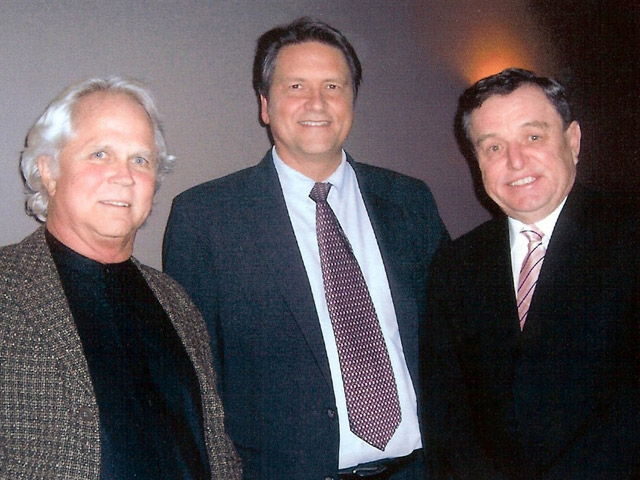
Tony Dow, left, with Jim Longworth, center, and Jerry Mathers, right

Most of us have a special place in our home where we display pictures of our family. For me that special place is a credenza that features framed photos of my wife Pam, my sister, our parents, and my two make-believe brothers, Tony Dow and Jerry Mathers.

From 1957 to 1963, Jerry and Tony played brothers Theodore and Wally Cleaver on Leave it to Beaver, a sitcom about the adventures of two siblings growing up in middle America. In later years, some revisionist media pundits would criticize the show as having painted an unrealistically positive picture of family life, but to millions of boys growing up in the 1950s and ‘60s, the Cleaver household was a great place to visit every week.

This fall, Leave it to Beaver will celebrate its 65th anniversary, and it’s also the anniversary of when Jerry and Tony’s lifelong friendship began. Jerry told me that despite their age difference, “We became friends right off the bat. Between takes, Tony would always toss football or throw baseball with me.” The two boys had also come from different backgrounds. Unlike his “brother” Jerry Mathers, who had been a child actor long before Leave it to Beaver, Tony had been a junior Olympic diving champion with absolutely no desire to be on camera. Once cast as Wally, though, Tony became one of TV’s first teenage heartthrobs. Yet despite all the fame and adulation that the show brought him, Tony remained a reluctant star with a non-existent ego.

After the show ended, both men continued acting, but Tony preferred to make his mark behind and away from the cameras, first as a director, then as a master sculptor, the latter giving him an escape from his earlier bouts of depression. Tony’s burl wood sculptures are world famous, and one of them was even displayed in the Louvre. Pam and I were fortunate enough to attend one of his one-man shows, and later visit with him and his lovely wife Lauren at their home in Topanga. We stayed in touch over the years by phone and email, and one of my favorite correspondences is a photo of Tony, Lauren, and their dog Brodie, with a note that said, “Hello Pam and Jim. We loved getting to know you and hope our paths cross again in the future.” Unfortunately, the future wasn’t as long as I had hoped it would be. During the pandemic, Tony fought off both pneumonia and liver cancer. The latter took him from us on July 27. Tony Dow was 77.

I first met Tony and Jerry back in May of 2008 when I was asked to produce and moderate A Mothers Day Salute to TV Moms for the Television Academy in North Hollywood. Barbara Billingsley, who played the boys’ mother on Leave it to Beaver, was scheduled to be on the panel with other iconic TV Moms, but she was hospitalized just prior to the event, and was unable to attend. That’s when I invited Jerry and Tony to attend on her behalf, and say a few words about what Barbara meant to them. Keep in mind that, prior to my introducing the Cleaver boys, the stage was already filled with dozens of A-list stars, including Cloris Leachman and Diahann Carroll, each of whom had received an enthusiastic welcome from the capacity crowd. But in all my years of producing and moderating special events, I’ve never witnessed a bigger standing ovation than the one that Tony and Jerry received when I brought them up on stage. I guess it wasn’t just me who had wanted to be their make-believe brother.

The following year during our visit to the Dows’ home, Pam and I were first struck by the natural beauty of their hide-away estate. It is a garden spot surrounded by the hills of Topanga Canyon, where Tony would hunt for pieces of burl wood, which he formed into bronze masterpieces at his workshop. Inside the house, we were treated to lunch and a front-row seat to one of Hollywood’s great romances, which began 42 years ago. Tony and Lauren’s love for each other was real and deep, and everlasting. The day after Tony died, Lauren told me, “It’s hard to lose your best friend.” 

Not surprisingly, during their four decades together, Tony preferred spending time at home with Lauren to the glitz of Hollywood red carpets, so I was particularly excited when he let me coax him into appearing on stage that special night in 2008. Honestly, though, I don’t think Tony appreciated what he meant to millions of people, and he seemed genuinely surprised by the grand ovation that he and Jerry received at the TV Moms event. I wasn’t surprised, though. That’s just the kind of humble guy my make-believe big brother was, and I miss him. Gee Wally, why’d you have to go and leave us so soon?


Bob Shackleford: a Selfless Legacy

Posted August 2, 2022 By Triad Today
Former Randolph Community College president Bob Shackleford

Former Randolph Community College president Bob Shackleford

“Legacy” is an overused word. A great athlete, for example, may claim that hitting lots of home runs is his legacy. The founder of a business is said to be leaving a legacy to his children when they succeed him. Kids whose parents graduated from an Ivy League University are automatically accepted in those elite schools because they are “legacy” students. But I believe the true meaning of the word has more to do with selflessness than with entitlement. That’s why when I look in the dictionary under the word “legacy”, there’s a picture of my friend Bob Shackleford.

Bob recently stepped down as president of Randolph Community College after serving in that position for 15 years, but he has been in education for most of his life. His journey to Asheboro included earning degrees in everything from secondary education to a Ph.D. in human development, and a Master of Divinity. He has been a teacher and a military chaplain, and along the way, he’s chaired everything from United Way campaigns to Economic Development Corporations. Yet, as impressive as Bob’s resume is, his accomplishments while serving as RCC President are even more so.

He built a state-of-the-art Allied Health Center, created a computer-integrated machining institute, expanded the welding center, nurtured a world-class photography department, negotiated an agricultural exchange program with an eastern NC university, created a student emergency fund, kept an apprenticeship program thriving even during the pandemic, and he started a student assistance program that helped to break down barriers to succeeding in college. “Most of the problems we deal with students are not academic. They wrestle with life, whether it’s taking care of children or an elderly parent, or dealing with health problems like depression or substance abuse. What we can do as a College is to help them”, said Bob. 

And, helping students succeed is at the heart of Bob’s legacy, as he told me during a conversation we had on Triad Todayearlier this year.


Jim: Why did you go into the education field?

Bob: Well Jim I grew up very poor. My family and I lived in a little trailer and moved around because of my Dad’s work, and I didn’t have a prayer. I didn’t know what I wanted to be or ever could be. And my Mom told me, “If you get your education and work hard, you can be anything you want to be.” I got my education, I’ve lived my dream, and I’m passing along the gift she gave to me to other students who are where I was.

Jim: It would take us a few hours to list all your accomplishments, but let’s talk about a couple of them, starting with your role as one of the driving forces behind the development of the Guilford/Randolph mega site. That’s paying off now with the Toyota battery plant coming in. What’s the economic impact of that project?

Bob: It’s going to be profound in the whole region and the whole State. They’re investing $1.3 billion dollars. They’re going to create over 1,700 jobs, with a salary of over $65,000. In phase two, they’ll invest another couple of billion dollars, and create thousands more jobs. Overall, the impact will be new housing developments, new schools, new churches, and new communities. And when it’s all said and done with all the new supply companies coming in, it will bring in about 15,000 new jobs.

And, it’s a tribute to Bob that he was on the front end of bringing those new jobs to the region, while on the back end he’ll be providing training for the folks who need those jobs. Speaking of training, Bob has been proactive in adapting and developing courses that will prepare students to meet the needs of area industry. That commitment is evident in RCC’s new Allied Health Center which is named for Shackleford.

Jim:  Why was the new center needed and how will it benefit students?

Bob: Well, the original center was just a nursing building. But we’ve added so many health programs since then that they were scattered all over the campus. We now have a state-of-the-art, high-tech allied health center with a simulated hospital, and it’s going to create jobs that are going to stay right here in the Triad. It’s supplying the need for nurses, radiographers, all kinds of health-related jobs that are not going to be transported overseas, they’re right here, well-paying jobs right here in the community.

Jim: What’s something else you’re proud of that you were able to accomplish during your tenure as President of Randolph Community College?

Bob: A number of years ago I campaigned for a 4-cent tax referendum. In fact, I gave 55 speeches in seven weeks, and I was told by a bank executive that Randolph County wouldn’t vote for a tax increase, but we won, and it ended up bringing $24 million dollars to RCC for advanced technology, the Allied Health Center, and so much more.

Jim: Why retire now?

Bob: My family decided it was their turn, and my little granddaughter said, “The college will have other presidents, but you’re the only papa I’ll ever have.”


You can’t argue with her logic. After all, it comes from someone who appreciates a legacy.


Vernon and the GOP Gun Raffle

Posted July 26, 2022 By Triad Today
Vernon Robinson

Vernon Robinson at a gun shooting range

A lot of folks seemed shocked when Vernon Robinson announced that he was organizing a gun raffle for the Forsyth Republican party. The Winston-Salem Journal criticized the local GOP for being “tone deaf” to the recent massacres in Texas and Illinois. In fact, according to Forsyth Democratic party chair Kevin Farmer, two of the assault-style rifles being raffled “appear to be” models used in the Highland Park massacre. Yet true to form, Vernon fired back, saying, “People like gun raffles and it is a great way to raise money. The only people who are upset about gun raffles are people who are hostile to guns and gun owners.”

If Vernon’s use of the word “people” sounds familiar as a misdirection from facts and reality, that’s because it is. A certain Republican president used to and still does attribute unsupported statements to “people say”. I’m a gun owner, so I obviously don’t hate gun owners. However, I oppose this particular raffle because it comes at a time when we shouldn’t be promoting the use of semi-automatic weapons. Still, if you know anything about Vernon Robinson, then nothing about his gun raffle should surprise you.

After serving two terms on Winston-Salem City Council, Vernon became a perennial also-ran for just about every other office on the state and local level. He was also known for his political grandstanding, like the time he placed a one-ton granite replica of the Ten Commandments at the front door of City Hall in an effort to show that God’s laws should be on full display at government buildings. To hell with the separation of church and state.

Vernon would say and do just about anything to get attention and to promote himself, ostensibly as a viable candidate for whatever elected position he sought at the time. He was a rare commodity: an ultra-conservative African-American Republican. In fact, he referred to himself as “The Black Jesse Helms”. He was also Trump before Trump was Trump. And that brings me to the election of 2004.

That year, George Bush was running for re-election and Rep. Richard Burr announced that he was giving up his congressional seat in order to run for the Senate. Burr’s announcement brought no less than eight GOP stalwarts out of the woodwork and into the race to represent the 5th district. The field included Ed Broyhill, Nathan Tabor, state Senator Virginia Foxx, and Robinson. Thanks to Vernon’s high profile, he came in first place in the July primary, but couldn’t muster the 40% he needed to avoid a run-off with Foxx, who finished second. The run-off was scheduled for August 10, so I invited both candidates to appear together on Triad Today the weekend prior to the election. 

During their joint appearance, Vernon was typically animated and bombastic, at one point accusing Virginia of “telling whoppers”. But the whopper meter spiked when I called out Vernon for repeatedly bragging about his military combat experience. “What war did you serve in Vernon?” I asked. “The Cold War”, he replied. I continued to press him for specifics about his actual combat experience until he finally admitted that he had none. As I said before, Vernon was Trump before Trump was Trump. Foxx went on to win the run-off, and Vernon later blamed me for his loss.

Had Robinson defeated Foxx in 2004, he would have been North Carolina’s first radical right-wing Congressman in modern times, and by January 6, 2021, he probably would have been up on the stage with Trump, urging the crowd (some of whom were armed) to march to the Capitol. Instead, he is a private citizen grabbing headlines any way he can, this time by using guns to raise money for the Republican party.  

You can call Vernon Robinson anything you like, but don’t make the mistake of thinking he is tone deaf. The fact is, when it comes to what the Republican base and its election-deniers are saying, Vernon hears them loud and clear.


Triad Today to Focus on Hospice

Posted July 20, 2022 By Triad Today
Mountain Valley Hospice Logo

Mountain Valley Hospice Logo

Both of my parents were fortunate to have been under hospice care before they passed away, so I can testify first-hand that the folks who provide patients with serious illness and end-of-life-care will someday occupy a special place in heaven. That’s especially true for the team at Mountain Valley Hospice & Palliative Care.

Mountain Valley Hospice, headquartered in Mt. Airy, serves an 18 county area in North Carolina and Virginia with offices and facilities located throughout the region. In addition to providing in-home care, they operate in-patient hospice homes in Dobson and Yadkinville.

Mountain Valley also offers special programs such as We Honor Veterans, and Camp Kids Path to help children deal with the loss of a loved one. They even offer a Pet Peace of Mind program, and, of course, they provide support for families of hospice patients.

This weekend, members of the Mountain Valley team will appear on Triad Today to talk about everything from access to care, to the importance of volunteers. The program was taped earlier, and will air this Saturday and Sunday. 

While some hospice agencies in North Carolina are for profit, Mountain Valley is non profit, so we began the show with a discussion about what that means to patients and their families.

“Our goal is to make sure that every patient who is hospice eligible can gain access to care,” said Stephanie Tilley, Senior director of Growth & Access. “Many folks are surprised to learn that only about 50% of patients who meet the eligibility for Medicare actually utilize the Medicare benefits.”

But even those who don’t meet Medicare criteria are never turned away.

“We take care of those who can’t afford to take care of themselves, those who have no insurance, no financial means. Our mission is to serve every patient, every family, every time,” said Tracey Dobson, President and CEO of Mountain Valley Hospice.

In order to provide charitable care for some patients, Mountain Valley Hospice relies on donations, and occasionally hosts fundraising events.

“Proceeds from these events go to support our patient services and community programs.  It’s what enables us to not have to turn anyone away due to an inability to pay,” said Sara Tavery, Senior director of Philanthropy and Volunteers.

The Mountain Valley Hospice team includes doctors, nurses, chaplains, and a large support staff. But that team of caring professionals is also complimented by an army of volunteers who help serve the needs of patients and their families. 

“Volunteers are truly the heart of hospice. We are so fortunate to have a great group of volunteers. They are vital to helping us carry out our mission, and to provide compassionate care to our patients,” Tavery said.

Like my parents, most patients receive hospice care in their own home./p>

“Nursing care is available 24/7 for patients in their own home. We have CNAs who can help with bathing and dressing patients. Our chaplains  offer spiritual support, and then we have social workers who help manage resources for our patients,” said Jenna Campbell, Chief Clinical Operations Officer.

Mountain Valley also operates two, state-of-the-art in-patient hospice homes for when at-home care is no longer practical.

“It’s when we can no longer manage the patient’s symptoms at home, so we need to take it a step up, and have the provider more involved at the bedside,” said Campbell.

But regardless of whether care is provided at home or in a hospice home, the goal is the same, as Chief Medical director Dr. Glenn Golazewski explained.

“It’s important to keep hospice patients comfortable, and that’s what folks want when they’re dealing with end stage illnesses.”

You can watch our Triad Today salute to hospice this Saturday at 7:30am on abc45, and on Sunday at 11am on MY48.

For more information about hospice care, visit MtnValleyHospice.org or to schedule an appointment, call 888-789-2922.


GSO ACC HDQ SOL?

Posted July 5, 2022 By Triad Today
ACC logo at the Greensboro Coliseum

ACC Tournament signage at the Greensboro Coliseum Complex

Ask a thousand people in the Triad to identify the current location of Atlantic Coast Conference headquarters, and most all of them would say, “the Greensboro Coliseum”. In fact, the ACC’s offices are nestled away at luxurious Grandover Resort. The man who runs the conference and works at Grandover is Jim Phillips, who is neither from Greensboro, nor has a history with the ACC. He is a Chicago native who went to school at Tennessee and Arizona State, and worked at Northwestern. Not surprisingly for someone with no ties to this area nor to our basketball traditions, Phillips, upon taking over the ACC last February, hired a Texas-based real estate advisory firm to help him decide where the conference headquarters should be located. Since then, Greensboro Mayor Nancy Vaughan and Guilford Board of Commissioners Chairman Skip Alston have been bending over backwards to offer Phillips perks and reasons why he should keep the ACC HQ in the Gate City rather than move to Charlotte, Orlando or some other locale. The latest lure was an offer to re-name the Greensboro Coliseum the “ACC Coliseum”. Meanwhile state lawmakers have allocated $15 million dollars to spend on keeping ACC offices in North Carolina.

Phillips has not given an exact date for making a decision on where the ACC HQ will be this time next year, but for all the stellar efforts being made by our local and state officials, it may be time to take a step back and really think about what we’re fighting for. Keeping the ACC offices in Greensboro and renaming the Coliseum has absolutely nothing to do with ACC basketball and the revenues that its men’s tournament produces for the host city. Sure it has been rumored that if Phillips stays put, we could count on the ACC tournament being played in Greensboro three times over the next 15 years, but what kind of a bone is that to throw at a community that has nurtured ACC basketball for nearly 70 years? Moreover, if the ACC moves to Charlotte, then why should Triad-area tax dollars be spent to relocate an existing business to a competing city? It’s a dilemma that the Greensboro News & Record pointed out in a recent editorial, saying if the state’s $15 million package is spent on moving Phillips and his 50 employees to Charlotte, it would be like, “robbing Peter to pay Paul.” Speaking on behalf of Peter, let me say that Paul shouldn’t get a dime of my money. The Queen City has already robbed the Triad of just about every major banking and healthcare headquarters, and taking the ACC from us would be the last straw.

The ACC and I were both born at the same time, and I have been a fan ever since, so obviously I’d like to see the conference offices remain in Greensboro. But I am also conflicted because it is beneath our local elected officials to keep begging a guy from Chicago to go to our local prom, especially when he’s not paying for the date. So, Mr. Phillips, if you want to stay, we’d love to have you, and if you want to leave, then Godspeed and don’t let the door hit you on the way out. It’s time to either pass the ball or shoot.


HPU, Mark Martin, and What If?

Posted June 28, 2022 By Triad Today
Former NC Chief Justice Mark Martin

Former NC Chief Justice Mark Martin

Earlier this month, just as Congress was about to convene hearings on how former President Donald Trump planned and attempted a coup, another president was proudly announcing that a Trump ally would lead his university’s new law school. That proud president is High Point University’s Nido Qubein, and his pick to take the reins of a new law school is none other than former State Supreme Court Chief justice Mark Martin. Qubein’s announcement couldn’t have been more poorly timed, and his choice of Martin couldn’t have been more inappropriate, because Martin was allegedly actively involved in helping Trump overturn a legal election and subvert the Constitution.

Both the Washington Post and New York Times stand by their stories that Martin joined the seditious Trump bandwagon early on, first by co-authoring legal briefs to help five states spread the Big Lie and seek to overturn the 2020 election, then by allegedly advising Trump himself that Vice President Pence could refuse to certify Biden electors when Congress convened on January 6.

The Charlotte Observer spoke with several legal experts who said that Martin’s actions on Trump’s behalf “undermined faith in the country’s elections, weakened its constitutional democracy, and set the stage for the January 6 mob assault on the Capitol.”

And Duke law professor Jim Coleman told the Virginian Pilot, “I think it’s quite damaging to have a former chief justice of the NC Supreme Court being associated with these positions. It calls into question how he (Martin) and perhaps others approach the law – not based on principle, but based on the result you want to achieve politically.”

The Virginian Pilot also spoke with Norm Eisen, an expert on law and ethics at the Brookings Institution, and Eisen’s rebuke of Martin was even more severe. Said Eisen, “ All the lawyers who whipped up Trump’s followers into a frenzy based on the completely baseless belief that the election had been stolen, must bear a share of the responsibility for what happened on January 6.”

Martin’s defenders say that because of attorney/client privilege, he can’t comment on his involvement with, or his advice about Trump’s attempted coup. Hogwash. Every first-year law school student knows that there is a “Crime-Fraud Exception” to privilege, which states that the exception can apply if the client is trying to further a crime, or is in the process of committing a crime. We now know from the Congressional hearings that Trump was fully advised by his own people that his subversive schemes were illegal, yet he continued to pursue a seven-point plan to overturn the election. For Martin to play any role in helping to advance Trump’s plan doesn’t make him a counselor, it makes him an accomplice.

But perhaps the most disturbing thing about Martin’s involvement in advancing the Big Lie, is just how close Trump came to staging a successful coup, and doing permanent damage to our democracy. Just imagine what kind of country this would be if Mike Pence had decided to follow Martin’s alleged advice, and reject Biden’s electors on January 6.  I shudder to think.

HPU’s law school can’t open without first gaining approval from the Southern Association of Colleges and Schools, and, given all we know about Martin’s alleged involvement with Trump’s attempted coup, SACS should hold off on approving Qubein’s new law school until more information is forthcoming. After all, it wouldn’t be appropriate for someone to teach students about laws that he allegedly broke.


Drag Queen Events Stir Protests

Posted June 21, 2022 By Triad Today
Drag queen performer Anna Yacht

Drag queen performer Anna Yacht

The Forsyth County Republican Men’s Club and Conservative Women of Forsyth County recently threatened to stage a protest during Bookmarks Drag Queen Story Time event, in which “Anna Yacht” was scheduled to read to children ages 3 to 7. Ken Raymond, chairman of the Forsyth Republican party explained the rationale behind such protests, telling the Winston-Salem Journal’s Katelyn Oglesby, “Drag Queen Story Time is a tactic of militant gay leftists trying to separate children from their parents in order to indoctrinate them.”

Before I attempt to unpack Mr. Raymond’s theory, it might be helpful to understand that people of all ages, both conservative and liberal, have, for centuries, been entertained by men dressed up as women. In Shakespeare’s time, for example, only men were allowed to perform on stage, so when rowdy Globe Theatre audiences saw a “woman” enter from the wings, they knew that “she” was actually an actor dressed as a woman. It is also believed that the term “drag” derived from how Globe actors had to drag their long dresses across the stage. Later, even as women were allowed to perform on stage, many male comedians made a living by wearing women’s clothing. In fact, those early vaudeville comics inspired the first King of television, Milton Berle, whose most popular character was that of a flamboyant female singer. Such cross-dressing performances continued as a staple of TV and motion picture comedies, with superstars like Cary Grant, Tony Curtis, and Jack Lemmon making audiences howl over their gender-bending antics. In the latter half of the 20th century, Divine was the poster “girl” for the drag queen movement, and in recent years, RuPaul has turned drag into a media phenomenon and helped to spur widespread interest in local drag queen events. Those include storytelling activities at public libraries and public schools, and that brings me back to the Bookmarks protest.

First, I don’t agree that “militant gay leftists” are trying to separate children from their parents, at least not at Bookmarks. After all, there aren’t too many kids ages 3 to 7 who can drive themselves to a Drag Queen Story Time event. Moms and Dads who see such events as family-friendly, willingly allow their children to be exposed to the messages of tolerance being taught by drag queens. But that doesn’t seem to matter to legislators in Texas, Florida, and Arizona, who have recently introduced bills to prevent minors from attending drag events of any kind, which they describe as “inappropriate sexual content” for the children present. Nevertheless, it should be up to the parent to determine what is and isn’t appropriate content for his or her child, and in that regard, the aforementioned proposed laws seem to discount parental rights. However, just as some parents fight against state laws that censor content, others have the right to do the opposite, that is, to fight for the right to protect their child from certain content. And that brings me to Drag Queen Story Time events at public schools.

Between January and May of this year, New York City public school officials have paid the Drag Story Hour company over $200,000 to conduct 49 reading sessions at 34 different schools, most of them at the elementary level, and all of them without parental consent.

Some NYC residents are concerned over the amount of taxpayer dollars being spent for Drag Queen events, while parents are livid over having no advance warning or input about the events themselves. The tipping point seemed to be a reading session back in April at a school in Manhattan in which “Harmonica Sunbeam” encouraged kids to choose their pronouns and invent drag names for themselves. Speaking with the New York Post, City Councilwoman Vickie Paladino said: 

“We are taking hundreds of thousands of dollars out of the pockets of hardworking New York taxpayers to fund a program teaching little children about their gender fluidity? Not on my watch.”

There are also complaints from parents about more than just content and messaging, mainly involving scantily clad folks at Pride events in which drag queens happened to participate. Those associations have served to conflate various concerns and controversies surrounding story time activities, and fuel the rhetoric about the “militant gay leftist” agenda. Forsyth GOP Chairman Ken Raymond referred to Drag Queen Story Time as “perversion”, and based that on his having watched a video in which children were allowed to put dollar bills down the G-strings of drag queens. And recently a London library had to apologize when a drag queen showed up at a summer reading event wearing a “Rainbow Dildo Butt Monkey” costume.

Obviously, drag queens should never wear obscene costumes around little children, nor should they encourage kids to engage in well-meaning, gender-related learning activities without first obtaining parental permission. Aside from that, parents who wish to bring their offspring to a story time event should be allowed to do so without interference from legislators or political protesters.


Institutional Child Sex Abuse… AGAIN

Posted June 14, 2022 By Triad Today
logo for the Southern Baptist Convention

logo for the Southern Baptist Convention

Just as with murder and other heinous crimes, I suppose that sexual abuse of children has probably gone on since the beginning of time. But there is also evidence to suggest that such abuse was institutionally committed and protected at least as far back as the 11th century. In 1051, Peter Damian, a Benedictine monk published Liber Gomorrhianus, in which he detailed sexual abuses of minors by Catholic clergy. We also know that such practices were common throughout history, including those reported by Martin Luther in 1531. In his book Out of the Storm: the Life and Legacy of Martin Luther, author Derek Wilson recounted Luther’s report about how Pope Leo X refused to restrict the number of boys that priests could keep for pleasure. Leo was also determined to keep this institutionalized sodomy from public scrutiny, a practice that many of his predecessors successfully continued until an inordinate number of victims began to come forward in this century. 

According to a study by John Jay College of Criminal Justice, between 1950 and 2002, no less than 4,392 active priests and deacons were accused of sexual abuse by 10,667 victims. But the number of reported abuses kept growing with each passing year. According to records of the Holy See, in 2014, Silvano Maria Tomasi testified before a committee of the United Nations, reporting that between 2004 and 2014 alone, the church investigated 3,420 cases of sexual abuse of minors, resulting in 884 priests being demoted to lay positions. Three years later Pope Francis admitted the problem was so vast that the Vatican had a backlog of more than 2,000 cases of sex abuse by priests that needed to be investigated.

Just as the Catholic Church was finally having to deal with these horrific crimes and start to compensate victims, so too was the Boy Scouts of America, whose leadership had, for decades, kept the names of child sex abusers hidden from public view. In 2019, ABC News reported that as many as 12,254 boy scouts had been sexually abused by 7,819 troop leaders and volunteers. Then in 2021, NBC News reported that a total of 84,000 former boy scouts had joined a lawsuit against BSA, resulting in a settlement of $850 million dollars. 

Some news pundits wondered if scouting would survive the scandal, and if the Catholic Church was serious about transparency and reforms. Meanwhile, others of us hoped that the worst of these abuses and cover-ups was behind us. Then last month, the Associated Press published excerpts from a 288-page report by Guidepost Solutions, which claimed that two Southern Baptist Convention leaders (now retired) had maintained a secret list of “hundreds of pastors and other church-affiliated personnel who had been accused of sexual abuse.” SBC interim president Willie McLaurin immediately issued a public apology, saying, “We are sorry to the survivors for all we have done to cause pain and frustration. Now is the time to change the culture. We have to be proactive in our openness and transparency from now.”

McLaurin’s apology is a good first step, but we also need to bring to justice those who committed the abuses as well as those who covered them up. Meanwhile, no one knows for sure how many minors have been sexually molested by SBC employees, Scout leaders, or priests because not every victim reports the crime, plus, the number of those who do come forward is growing daily. What we do know, however, is that, according to the CDC, 91% of child sexual abuse is committed by someone who is known to and trusted by the child or the child’s family. The question now is, will victims ever again come to trust the institutions that caused them so much pain, and are those institutions serious about reforms that could help to rebuild that trust? I hope the answer to that question is “Yes.”


Taxes and Bonds and Schools, Oh My!

Posted June 7, 2022 By Triad Today
Cartoon drawing of James Madison and Alexander Hamilton holding a copy of the Federalist Papers

Artwork from The Partially Examined Life podcast

In 1787, Alexander Hamilton, John Jay and James Madison penned a collection of essays that were published in what has since become known as “The Federalist Papers”. The focus of their essays was primarily to promote ratification of the Constitution, but some of what they wrote also served as a road map for how citizens could stay engaged in government and governance. For example, in Federalist #49, Madison wrote:

“As the people are the only legitimate fountain of power, and it is from them that the constitutional charter is derived, it seems strictly consonant to the republican theory to recur to the same original authority…whenever it may be necessary to enlarge, diminish, or new model the powers of government.”

One could interpret Madison’s statement as referring to the need for legislators and voters to amend the United States Constitution as needed, but, in a sense, I believe he was also foreshadowing the need for enacting local reforms and funding mechanisms, such as when, in 1949, North Carolina voters overwhelmingly approved a school construction bond 69% to 31%, or in 1996 when we passed a $1.8 billion dollar bond that would improve public school infrastructure. Then there was the Connect NC economic development bond in 2016, in which voters approved spending $2 billion dollars, much of which went for improving community college campuses. But for the most part, it has been up to voters in each county to decide when and how we should float bonds and spend taxpayer dollars on local school projects. And that brings me to last month’s school bond referendum, in which Guilford County residents voted to spend $1.7 billion dollars on school construction and maintenance projects.

The Guilford measure passed 61% to 39%, so obviously, county residents believed it was time to spend money on schools. But on election day, those same voters rejected a quarter cent increase in sales tax by a margin of 55% to 45%. Here’s where it gets confusing. In fact, I think James Madison would be scratching his head at the incongruity of those results. That’s because what Guilford voters didn’t seem to realize is that an increase in sales taxes would help us retire the debt on the bond that they just approved. Instead, county commissioners are having to set aside $50 million dollars of the next budget to help pay for the $1.7 billion dollar bond, AND much of that money will come from a hike in the property tax rate.

The ironic thing about voters approving the school bond, but not the rise in sales tax, is that the latter not only would help pay for the former, but levying taxes on the sale of goods is the most equitable revenue-producing system that we have. For example, if I can afford to buy a new lawnmower, and you can afford to buy a yacht, then we both pay sales tax at the same rate. The sales tax on my new lawnmower might be $20 and the sales tax on your new yacht might be $20,000. But if property tax rates go up and I’m struggling to make ends meet, I may not have enough money to pay the increase, much less buy my new lawnmower.

There are those who believe that Guilford County Commissioners will try and put the sales tax issue back on the ballot in November, but unless they do a better job of educating voters about the benefits of raising the sales tax rate versus raising property taxes, then as likely as not, the outcome of that referendum will be the same as the one before.


Our Children Are Massacred… AGAIN

Posted May 31, 2022 By Triad Today
Robb Elementary School in Uvalde, Texas after the May 24 shooting

Robb Elementary School in Uvalde, Texas after the May 24 shooting

For the past 20 years, I’ve been calling for all schools to have armed officers with metal-detecting wands placed at every entrance, but I’m always told by politicians that my plan is impractical and would be too expensive. Yet less than a week after Congress allocated $40 billion, unbudgeted, to stop the carnage in Ukraine, we had carnage here at home, and once again, it occurred in a classroom.

What happened in Uvalde, Texas on May 24 was horrific.

After shooting his own grandmother, an 18-year-old male shot and killed 19 little children and two teachers at Robb Elementary School. We don’t know his motivation because he is no longer alive to tell us. We don’t know how long he had been planning to purchase two assault-style rifles. We don’t know if he had threatened violence before, or if he was making some sort of political statement. There is a lot about this tragic incident that we might never know. But we know what he did, and we know who he did it to, and that should be enough for our elected officials to finally take action. History tells us they won’t. They didn’t take action after Columbine or Sandy Hook, or Parkland, so why expect them to act differently now. Sure, there will be plenty of “thoughts and prayers” offered, but politicians aren’t likely to do anything now that will make thoughts and prayers unnecessary in the future.

Our kids used to have fire drills at school, now they have shooter drills. But, drills don’t prevent violence, they only react to it. Yes, we need tougher gun laws, including thorough background checks and a higher minimum age for purchasing those guns. Yes, we need more comprehensive mental health screenings and better inter-jurisdictional communication among law enforcement agencies. And yes, we need to put parents in prison who make guns readily available to their kids. But even if you outlawed the sale of all guns, keep in mind that there are already more guns in circulation than there are people in this country. Translation? Most anyone can get his hands on most any kind of gun. Regardless, reforms of any kind take time, so what we need right now is better school security.

Sure, I understand that my solution will cost a fortune, and it isn’t 100% foolproof. After all, armed officers stationed inside of a building can’t always stop shootings that occur outside of school buildings, but they can at least be in position to neutralize shooters quicker in those instances. Believe me, I’ve heard all of the arguments on the left and the right as to why more police and metal detectors aren’t the answer. But do we really want to tell parents at Sandy Hook, Parkland, and Robb elementary that school security costs too much money? We are the wealthiest nation in the world, yet it seems that our local, state, and federal governments have funds for everything except school security and that just makes no sense. It’s also sadly ironic that our elected officials love to argue about the sanctity of life before birth and then ignore the sanctity of life after birth.

A law enforcement official once told me that schools are like small communities, and that the children who comprise those communities deserve all of the same protections afforded any other community. Unfortunately, that’s not the case here in America, and now 19 more children are dead. But hey, school security would cost too much, wouldn’t it? Better to just do nothing and bury our heads in the sand. That’s what we’re good at. We’re also good at burying children. Too bad we can’t stop doing the former in order to stop having to do the latter.


Gun Shows Paid Not to Show

Posted May 24, 2022 By Triad Today
Greensboro Coliseum Complex managing director Matt Brown

Greensboro Coliseum Complex managing director Matt Brown

During the final battle in Star Trek VI: The Undiscovered Country, Klingon General Chang incessantly quotes Shakespeare while Spock and Dr. McCoy try frantically to prepare a torpedo that will put the chatty villain out of his misery. “I’d give real money if he’d shut up,” said McCoy. And so, even centuries into the future, we humans are willing to pay for someone not to do something. In Dr. McCoy’s case, he was willing to pay Chang not to talk. This kind of self-inflicted, or reverse extortion is nothing new. 

During World War II, the federal government provided support to America’s farmers to help them ramp up crop production. After all, an army travels on its stomach. But, according to FarmingBase.com, patriotic growing soon exceeded demand and, by war’s end, we were left with an “oversupply for basic crops such as corn, cotton, tobacco, rice, peanuts, and wheat.” Soon, the government found itself paying farmers NOT to grow certain crops. Eventually price support became a political hot potato (pardon the pun), and folks who struggled to make ends meet, weren’t too happy about their tax dollars paying farmers (including large conglomerates) not to farm. That’s when the Feds started putting a spin on the compensation program. According to PBS News Hour’s Robert Frank, the justification was that retiring acreage would reduce fertilizer and pesticide run-off into the nation’s water supply. Said Frank, “The Federal government described the price support program as an environmental program rather than an ‘income maintenance scheme.’”

But agriculture wasn’t the only industry affected by the “pay not to play” system. For decades now, it has been common practice for top executives, TV anchorpersons, and others to be paid huge salaries in return for signing a non-compete contract. In other words, “we’ll compensate you extremely well now, so that whenever you leave, you can’t work for the competition.” And then there’s the more recent “catch and kill” scheme in which a newspaper or media outlet is paid to sit on a story that it owns, to the benefit of the person who paid them not to publish that story. The thought of an editor being paid not to publish something is offensive, but then, so is a city government paying a vendor not to vend, and that brings me to the Greensboro gun show saga.

For as long as I can remember, gun and knife shows have been held at the Greensboro Coliseum. But, given the rise in mass shootings and a growing feeling among many on the left that gun manufacturers and ineffective laws are to blame for the carnage, some venues across the country are being pressured not to book these weapons extravaganzas. To that end, last week it was revealed that the city of Greensboro has agreed to pay gun show promoter Rodney Sorrell, almost $400,000 NOT to hold his gun show at the Coliseum (or anywhere else within the city limits) for the next five years. 

Just as the Feds once put a spin on price supports, a Coliseum spokesperson did his part by telling the News & Record that not having gun shows would free up the facility for holding “youth sporting events.” Meanwhile, managing director Matt Brown says that the city can make more money from hosting other types of events. But invoking youth and new revenue streams amounts to nothing less than gaslighting the public, which was left out of the loop on the decision to pay a gun show not to show up. It’s also ironic and runs counter to local efforts to curb gun violence because in 2018, city council voted to designate gun show revenues to a program that rewards citizens for reporting illegal guns. 

Paying someone NOT to do something is always problematic for one reason or another. It’s also self-inflicted extortion. In this case, the City of Greensboro isn’t being extorted by the gun promoter. Rather, the city voluntarily offered Sorrell a fat paycheck when Matt Brown pointed a gun at his own head and said, “Please take our money.” Yes, our gun laws need to be more comprehensive, but we also need to be careful about canceling legal events, much less paying them not to occur. True, Mr. Brown has sole authority to deal with contracts, but he is still a City employee. Moreover, he is the City’s highest-paid employee, yet doesn’t seem to answer to anyone, including the taxpayers. Perhaps as we re-evaluate the way we regulate guns, we also need to re-evaluate the parameters of Mr. Brown’s autonomy before he pulls the trigger on any more deals.