Commentaries Archive


JFK and the First Thanksgiving

Posted November 23, 2021 By Triad Today
President John F. Kennedy

President Kennedy pardoning a turkey for Thanksgiving
Presidents are only human, so they make mistakes. No, I’m not talking about Bill Clinton hooking up with Monica Lewinski, or Joe Biden falling asleep at a global climate conference. I’m talking about John Kennedy, and how he misread history, unintentionally insulted the Commonwealth of Virginia, and was compelled to make amends.

The story begins on Wednesday December 4, 1619. That’s the day 38 English settlers from the London Company navigated their ship down the James River and onto Berkeley Hundred (Harrison’s Landing), in what is now Charles City, Virginia, just 20 miles upstream from Jamestown, which had been settled twelve years prior. The landing party was led by Captain John Woodlief, who, as prescribed in the company charter, ordered a day of Thanksgiving to be observed upon their arrival, and every December 4th thereafter.

Over time, Berkeley became known for its historic firsts. The first bourbon whiskey was made there in 1621 (by a preacher no less). “Taps” was played for the first time while the Union army was encamped at Berkeley in 1862. And, of course, it was the site of America’s first Thanksgiving. More on that in a moment.

In 1907 Berkeley was purchased by John Jamieson who had served as a Union drummer boy during the army’s encampment at the plantation. Ownership later fell to his son (and my friend) Malcolm, who passed away in 1997. Mac loved Berkeley and was aggressive in marketing the historic site, including through the use of promotional videos and commercials which I helped to produce. He invited the public to tour the house and grounds, sold Berkeley boxwoods and bourbon, and held an annual Thanksgiving pageant which attracted tourists from across the country. But the celebration wasn’t always widely recognized.

One hundred years after his father beat the Yankee drums at Berkeley, Mac was upset by something another Yankee did. In the fall of 1962, President Kennedy issued his yearly Thanksgiving Proclamation in which he recognized his home state of Massachusetts as the site of America’s first Thanksgiving. And so, on November 9th of that year, Virginia state Senator John Wicker was prompted by Mac to write to the President, and point out Kennedy’s faux pas. In his telegram, Wicker referenced historical records about Berkeley’s celebration, which took place one full year before the Pilgrims landed at Plymouth in 1620.

Later that year, Kennedy confidant and noted historian Arthur Schlesinger sent a reply to Wicker with a tongue-in-cheek apology from the President. According to Berkeley records, Schlesinger “attributed the error to unconquerable New England bias on the part of the White House staff.”

The following year, on November 5, 1963, President Kennedy had to eat crow during his annual Thanksgiving proclamation, saying, “Over three centuries ago, our forefathers in Virginia and Massachusetts, far from home, in a lonely wilderness, set aside a day of thanksgiving.” Kennedy’s New England bias wouldn’t allow him to disavow Plymouth entirely, but Mac was happy that Berkeley finally gained official recognition for holding the first Thanksgiving, even if it was a shared honor. Sadly, it was to be Kennedy’s last proclamation. He was assassinated seventeen days later in Dallas.

The holiday season is now upon us, and because of the lingering pandemic, many of us will still forego our traditional Thanksgiving gatherings. We’ll celebrate with loved ones via Zoom, Skype, and old fashioned phone calls, and we’ll remember those who are no longer with us. And, despite the tragedies and restrictions of 2020 and 2021, we will find a way to give thanks for what we have and who we’re with. Perhaps we would also do well to emulate those weary English settlers, and just be thankful for surviving another day of our long journey. So here’s a Berkeley bourbon toast to Captain Woodlief, a little drummer boy, old Mac, and to that Yankee president who finally set the record straight.

God bless, and Happy Thanksgiving.


GOP-Drawn Maps Will Cheat Voters

Posted November 9, 2021 By Triad Today
A map of the southeast United States with a mottled red-and-blue pattern covering North Carolina

A map of the southeast United States with a mottled red-and-blue pattern covering North Carolina

If you watch enough old movies, you know that there are two types of bank robberies. The first kind is where the bad guys wait until the middle of the night when folks are asleep, then break into the bank and dynamite the safe. Then there’s the other kind of caper, where the bad guys are so bold and arrogant, that they rob the bank in broad daylight. The latter approach is a real insult to the townsfolk because not only are you stealing their money, you’re also thumbing your nose at them while you’re fleecing them. That’s how it is with Republican legislators in Raleigh every time they commence to re-draw the state’s congressional districts. Last week they did it again.

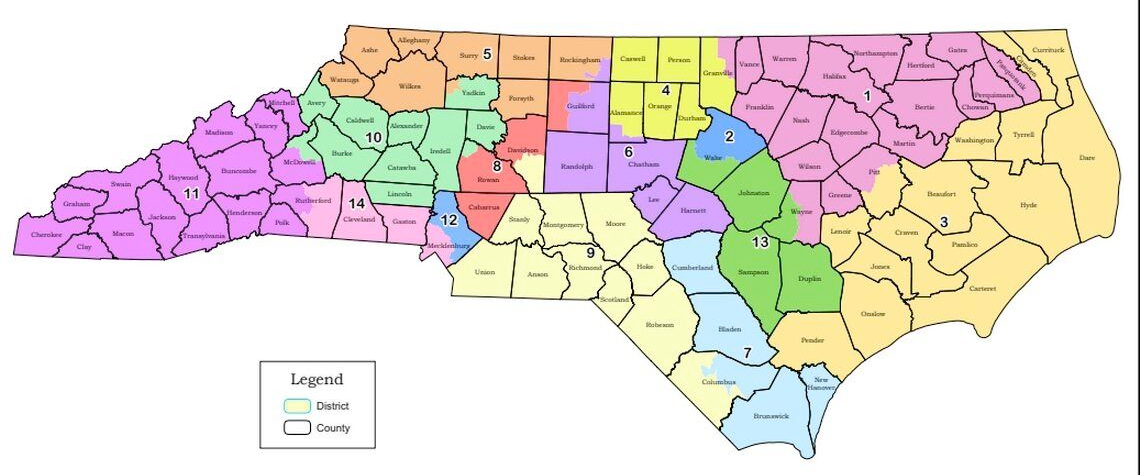
Thanks to the latest U.S. Census, North Carolina picked up an additional seat in Congress, which will bring our total delegation to fourteen representatives next year. According to the State Board of Elections, there are more Democrats registered to vote than there are Republicans. In fact, GOP registration (1.5 million) comes in third behind Dems (2.1 million) and unaffiliated voters (2 million). And so, you’d think that when the new district lines are drawn, there’d be a majority Democrats, for example, an 8-to-6 split. But a funny thing happened on the way to the drawing board. Republican lawmakers have come up with a new map that could easily give them eleven congressmen to the Dems’ three. How is that possible? One word: gerrymandering.

Instead of grouping entire counties into a single congressional district, the GOP map as proposed, carves up counties in such a messy way that it would make a butcher cringe. For example, Kathy Manning currently represents the 6th Congressional District, which includes all of Guilford and most of Forsyth, and takes in all three of the Triad’s largest cities, Greensboro, Winston-Salem, and High Point. But according to initial reports, the GOP map would divide Guilford county into three separate districts, and pit Manning against Watauga’s Virginia Foxx.

Groups like the NAACP and Common Cause believe the GOP map would make it unfairly difficult for Democrats and minorities to win a seat in Congress, and they have filed suit to ask that racial data be considered when drawing the new districts, so as to comply with the federal Voting Rights Act. Meanwhile, elected officials are openly complaining about the corrupt system of gerrymandering.

“It’s not coincident that it’s only in the urban areas that you subject these counties to that kind of treatment,” said Senator Dan Blue of Wake County. And Manning added, “The proposed lines are not a reflection of the best interests of North Carolina but rather, an offering to the national Republican party.”

A few years ago, a class of 8th graders at a Pennsylvania middle school was given the assignment to draw an equitable congressional map. In short order, they divided up districts according to population while respecting county boundaries as much as possible. It was hailed as a blueprint for ensuring fair and balanced representation among races and political parties. Clearly what we need here in North Carolina is a bunch of kids to draw our new congressional map. The problem is there’s never an 8th grader around when you need one.


McManus Gets High Marks for First Year on the Job

Posted November 2, 2021 By Triad Today
Winston-Salem Forsyth County Schools Superintendent Tricia McManus

Winston-Salem Forsyth County Schools Superintendent Tricia McManus
When most folks start a new job, they expect to enjoy an uneventful period of quiet transition, with plenty of time to settle in. Not so for Tricia McManus, who is just now winding up her first year as superintendent of the Winston-Salem Forsyth County schools. And what a year it has been. From day one she was faced with transitioning students from pandemic-related at-home learning, back to the classroom, all the while keeping an eye on COVID surges and variants that could affect who could return and when. Then came heated debate over mask mandates, followed by politically fueled battles over vaccines. McManus then had to deal with the fatal shooting of one student by another, while keeping an eye on TikTok challenges that encouraged vandalism and assault. I kept waiting for things to settle down so I could invite her to appear on Triad Today, but even on the day we scheduled our interview, she first had to avert a strike by school bus drivers, and then meet with students. Fortunately, Tricia McManus has boundless energy, and a genuine positive attitude about everyone and everything. It’s no wonder that school board member Dana Caudill Jones said of McManus, “She’s the perfect leader for our district.”

I caught up with Tricia recently at the WSFCS Cable 2 studio, and we taped a segment for Triad Today. Here are a few highlights of our conversation.


JL: You graduated from the University of South Florida, and later became assistant superintendent of Hillsborough schools, so I’m assuming you have deep roots in Florida.

TM: [smiles] Born and raised in Tampa.

JL: Who or what led you to a career in education?

TM: Both of my parents had degrees in education, and my father was a physical education teacher for his entire career, that was over 40 years. He was also the winningest high school football coach in Hillsborough County up until the time he passed. But he was an amazing educator, and the stories he would tell us, the summers we spent with him at the gym, education was just in our blood. As a result, five of the eight children in our family are educators.

JL: You were named interim superintendent last November, then took over the post officially in February of this year, and had to hit the ground running because of the pandemic. We’re still not out of the woods yet, but give me your assessment of how the school system has weathered the COVID storm thus far.

TM: Last year our district staff really rose to the occasion with response to everything from feeding our families when we were not in school, to making sure our schools were equipped to return in a safe manner. They responded to every single protocol, from removing furniture, to our custodians keeping buildings clean. There was a huge amount of work, and our staff were absolutely amazing. Still, it was not an ideal situation. Many of our students struggled last year with the isolation and not being in school the full year, and so our academic results have declined.

JL: But you need to put an asterisk behind those statistics because what happened was nobody’s fault.

TM: Absolutely. It happened everywhere across the country, but it is still impactful to our students. There have also been a lot of issues around trauma and mental health, and families dealing with loss, and all of the changes that occurred are real for our students as they returned this year. And so yes, as you said, it’s not over. We’re still dealing with COVID, and with all of the protocols and procedures that come with that. But I will say that even with all those challenges, we are educators, and educators are strong and resilient, and we are here for our students. So that keeps us moving forward even amidst the challenges.

JL: As you know, there are more guns in circulation in America than there are people, so it’s not surprising that kids have access to guns. Nevertheless, what steps are you taking to at least keep guns out of schools?

TM: Sadly those are not new statistics. Guns have been in schools for a long time, but the good news is that every time we’ve had one, they’ve been reported, and so when kids know something, they’re saying something, and that’s amazing.

JL: What’s the most gratifying thing about your job?

TM: It’s being in a classroom with kids. It’s seeing our students smiling. It’s seeing them engaged in learning, and it’s seeing them interact with staff in a positive way. It’s seeing our students be successful. That’s what it’s all about.


Remembering Betty Lynn, AKA Thelma Lou

Posted October 26, 2021 By Triad Today
Actress Betty Lynn

Betty Lynn as Thelma Lou kissing Don Knotts as Barney Fife in a promotional photo for The Andy Griffith Show
No doubt Andy Griffith is Mt. Airy’s most famous native son. After all, he created The Andy Griffith Show, a TV series set in a fictional version of his hometown, which has aired continuously since 1960. Andy is also revered in Mt. Airy because when NAFTA all but killed the furniture and textile industries there, the town fathers parlayed the popularity of Andy’s iconic television show into a life-imitating-art tourism destination. There are Mayberry-themed shops and diners along Main Street. There’s a life-like statue of Andy and Opie adorning the grounds of the Andy Griffith Playhouse and museum. And, every year the Mayberry Days festival attracts fans from all over the world. Yet for all that his namesake has done for Mt. Airy, Andy himself was never a hands-on cheerleader for his hometown. He never attended a single Mayberry Days festival, and rarely returned to Surry County for public events. Instead, the title of Mt. Airy’s cultural ambassador belongs to Betty Lynn, an unassuming actress who played Thelma Lou, the girlfriend of Sheriff Andy’s Deputy Barney Fife, played by Don Knotts.

Born in Kansas City Missouri, Betty Lynn followed in her mother’s footsteps and pursued a career in show business, first by traveling with a USO tour, then landing supporting roles on Broadway. The entire country finally got their first look at Betty in 1948 when she had a small role in the film Sitting Pretty, and, after that, more movie appearances followed. She also found regular work in episodic television before being cast as Thelma Lou, a character who came to symbolize the ideal girlfriend for every knuckle-headed guy in America.

Over the years, Betty had visited Mt. Airy several times, and had fallen in love with the town and its people. So, after her house in Los Angeles kept getting burglarized, she relocated to the town that inspired Thelma Lou’s Mayberry. That was in 2007, and ever since, she has given her time and talents to promote the TV show and her adopted hometown. That commitment included attending every Mayberry Days Festival, and appearing once a week at the Andy Griffith Museum where she signed autographs for adoring fans. Mt. Airy’s ambassador continued to give of herself until illness and old age would no longer permit it. Betty Lynn passed away on October 17. She was 95 years old.

I first met Betty in 2008 when she enthusiastically agreed to appear on my Triad Today show (video available at JimLongworth.com). Here are a few highlights of our conversation:


JL: Some folks think that your career began with The Andy Griffith Show, but you were already a seasoned actress before that, both on stage and in film.

BL: That’s right. 20th Century Fox brought me out from a show I did on Broadway. They tested me in New York on 8th Avenue.

JL: I was tested once on 8th Avenue, but that’s another story.

BL: [laughs] So that’s how I came out to California.

JL: How did you land the job as Thelma Lou?

BL: By then it was 1961, and I was under contract to Walt Disney Studios, doing a series called Texas John Slaughter, a western with Tom Tryon. While we were on hiatus, I got a call from the casting director, and she wanted me to come and read for a part on The Andy Griffith Show. Well, I had only seen the show twice before, and I was so impressed. I laughed out loud watching it, and I was all alone in the house. And I thought, “Oh my gosh, this is a funny show. They are really good.” So, I went in and I read for Bob Sweeney, the director, and Aaron Ruben, the producer, and when I finished they said, “We’d love to have you do this role”. And I said, “Well I’d love to, but I’m under contract with Walt Disney,” but in the meantime Disney dropped our show.


Disney’s loss was Mayberry’s gain, yet Betty confessed that she never had a contract with the Griffith show, and instead just kept getting called back as a recurring character. Her portrayal of Thelma Lou was so beloved and memorable, however, that it seemed as though she was in our living rooms every week. In truth Betty Lynn only appeared in 26 episodes, but for the next 60 years, she embraced that iconic role and used it to help promote America’s favorite fictional town, and the real town that inspired it.

Thelma Lou and Barney finally got married in 1986 on Return to Mayberry, a highly rated TV reunion movie, but in real life, Betty Lynn never tied the knot. Nevertheless, she was blessed with a huge family of fans and friends who adored her. At the end of our interview I said, “I hope you don’t mind when I slip and call you Thelma Lou.” Betty leaned over, kissed me on the cheek and said, “Oh no. I love Thelma Lou”. So do we, Betty. Rest in peace my friend.


We Need to Clarify Powers of Lieutenant Governors

Posted October 19, 2021 By Triad Today
Mark Robinson, lieutenant governor of North Carolina

Mark Robinson, lieutenant governor of North Carolina
Although technically incorrect, I was always taught that the polite way to address a lieutenant governor is to call him or her, “Governor.” It sounds like an instant promotion, but it’s just a respectful formality, unless of course, the lieutenant governor in question abuses the title.

Earlier this month, North Carolina’s lieutenant governor Mark Robinson became an instant object of derision for remarks he made to the congregation of Asbury Baptist Church in Seagrove last summer. Speaking about the kinds of things he doesn’t want our children to be exposed to while in a school classroom, Robinson said, “There’s no reason anybody anywhere in America should be telling any child about transgenderism, homosexuality, any of that filth.”

Ever since a video of his speech was posted, Robinson has come under fire from a host of high-profile groups and individuals. They range from The Human Rights Campaign to President Biden, and all of them have called on the lieutenant governor to resign his office. Meanwhile, Gov. Roy Cooper called Robinson’s remarks “abhorrent.” But if Cooper is smart, he better only utter his criticisms of Robinson from within our state borders. That’s because according to the North Carolina Constitution, the lieutenant governor assumes the powers and responsibilities of our governor anytime the chief executive is incapacitated or leaves the state.

Of course, there’s no real worry that Robinson would ever take advantage of a Constitutional loophole. Or is there? For an answer to that question, let’s examine what happened in Idaho just two weeks ago.

While Idaho Governor Brad Little was on a fact-finding trip to the US/Mexico border, his lieutenant governor, Janice McGeachin issued several executive orders on her own authority, including one that extends a ban on COVID vaccine mandates. McGeachin also attempted to order the Idaho National Guard to the Mexico border. Fortunately, Gov. Little hurried home and rescinded all of the hare-brained actions taken by Ms. McGeachin in his absence.

Given the dangerous divisiveness in America today, we must guard against any elected official being able to implement his or her own wacky agenda, especially when they aren’t even legally elected to the office which they are usurping. In Idaho, Lt. Gov. McGeachin’s power grab was short-lived and without any real consequence. And here in North Carolina, Lt. Gov. Robinson’s homophobic views didn’t translate to executive action since Roy Cooper was still in residence. But Idaho and North Carolina may have just dodged a bullet. That’s why every state needs to amend its Constitution, so as to update and specify the conditions under which a governor can be replaced by his second-in-command.

It’s important to keep in mind that the powers of North Carolina’s lieutenant governor were created by our State Constitution in 1868. Back then if a governor traveled out of his home state, he could be gone for weeks or months with no way of enacting orders until his return. Moreover, there were no telephones in 1868. There was no texting, no emailing, and no faxing. But that was then, and this is now. Today if Roy Cooper has to leave the state, he can communicate instantly with his staff in Raleigh should the need arise. In other words, a governor in this century is not incapacitated just because he’s attending a conference a thousand miles away from home, so there’s no justification for transferring power to the lieutenant governor simply because of a temporary absence. But until our constitution can be amended, governors would do well to remember an old Mafia saying, “Keep your friends close, and your lieutenant governor even closer.”


Time May Be Up for TikTok

Posted October 12, 2021 By Triad Today
TikTok logo

TikTok logo on a ringing alarm clock
Earlier this month former Facebook employee Frances Haugen told Congress that Facebook has a negative impact on teenagers, creates divisiveness, and consistently chooses profit over safety. During her testimony up on Capitol Hill, Haugen produced thousands of internal documents containing some rather alarming data. For example, 13.5% of teenage girls said Instagram worsens suicidal thoughts, and 17% said Instagram contributes to their eating disorders. Ms. Haugen also likened the addictive nature of Facebook and Instagram to that of cigarettes. Not surprisingly she called on Congress to reign in, regulate, and reform the social media giant. But as harmful as Facebook can be to kids, there is another platform that may be worse. It’s called TikTok.

TikTok is a social networking service that encourages young people across the globe to produce and post all sorts of narcissistic videos. Granted, most of the videos are merely obnoxious, but others are obscene, cruel, and encourage violent behavior. The latest TikTok craze is a series of challenges whereby students are encouraged to vandalize school property and worse. One such challenge tells students to have a bowel movement, then smear their feces on school walls. A Triad area parent recently told me about a student in her son’s school who took the challenge, and engaged in fecal smearing, then got caught when someone posted the dirty deed on video. Ironically, the mother of the vandal wasn’t upset about the fecal incident, rather she was angry that once the video went viral, her son had to endure cyberbullying from students who disapproved of the boy’s stunt.

And then there’s the “Devious Licks Challenge” and “Slap a Teacher Challenge” which have educators across the country concerned for their safety, and rightly so. Already a school teacher in South Carolina has been victimized by the challenge when a student slapped her in the back of the head. Then last week, a 64-year-old, wheelchair-bound teacher was attacked by a Louisiana high school student. Meanwhile, incidents of vandalism continue, with over a half dozen States reporting damage to and theft of school property. In Connecticut, these challenges have caused so much concern that Attorney General William Tong has asked TikTok executives to meet with parents and educators to work together to prevent any further incidents.

Such cooperation is certainly welcome, but I’m not so sure it will net any substantive results. For example, one school district in Oklahoma sent the following message to parents: “If your child uses social media, please talk to him/her about being socially responsible and kind.” It’s a nice thought, but a bit naïve, and probably too little too late. That’s because, as MyParentingJournal.com points out, “Parents must teach these things to their children at an early age.” Granted I grew up in the 1950s, but my parents drilled common sense into my head before I ever started school. I knew from age 5 not to cross the street unless I looked both ways first. I was taught not to get into a car with a stranger. And, I was taught to respect my elders, which included not slapping them in the back of the head. And please don’t tell me that I’m too old to understand “influencers” just because social media didn’t exist 68 years ago. Kids have always been susceptible to influence of one kind or another, and from all sorts of people, old and young alike. However, if they learn common sense and common courtesy early on, then they are less likely to blindly follow anyone or anything that doesn’t pass the smell test (fecal smearing notwithstanding). The problem is that not even teaching a child right from wrong guarantees that those lessons will stick. According to AConsciousRethink.com, “Some people are better at judging cause and effect than others, or understanding the consequences of their actions.” Of course, that’s true, which is all the more reason to believe that emails to parents won’t solve this problem.

Just as Frances Haugen called on Congress to reform Facebook, so too must we demand that TikTok and all other such platforms be regulated. Fortunately, our elected officials are finally becoming woke to the dangers of social media, and hopefully, their new found awareness will lead to a swift crack-down on anyone who presents or facilitates the dissemination of harmful material. So, beware TikTok, your day of reckoning may be coming soon. The handwriting is on your fecally smeared wall.


The College Gender Gap

Posted October 5, 2021 By Triad Today
Blue and pink gender symbols wearing graduation caps

Blue and pink gender symbols wearing graduation caps
By the time I was a junior in high school, I had already embarked on a career in broadcasting. My first job was as a weekend announcer at WSJS radio in Winston-Salem. I was jazzed about the work, and all I could think about was landing a full-time position and skipping college. But no one in my extended family had ever graduated from college, and I knew it would mean a lot to my parents for me to be the first. Nevertheless, I was not going to give up my weekend job, so that meant I would need to attend a college that was close to work. That’s when I decided to drop by the UNCG admissions office and see if they would take me. Then as now, I was not particularly good-looking, but the woman who greeted me just about leapt out of her chair when she saw me. I was flattered until I found out the reason for her excitement. Not only did UNCG want me to enroll, they NEEDED me to enroll. That’s because the University was still transitioning from single-gender to coed, and on the day of my visit, women outnumbered men by a ratio of 7 to 1. It was a win/win for everyone. UNCG landed another male student, and I was able to keep my radio job, work at the campus TV station, and get a college degree. I apologize for boring you with my personal story, but I promise there is a more universal point to this saga.

A chart showing the percentage of overall college enrollment of each gender for the years 1970-2026UNCG’s coed transition aside, that same year, a national survey showed that men comprised 59% of all college students, and women comprised 41%. But a not-so-funny thing happened over the next 50 years. Last week, Scott Galloway, clinical professor of marketing at the New York University Stern School of Business, told CNN’s Michael Smerconish that college enrollment is now 60% female and 40% male, with every indication that the latter figure will continue to decline. In fact, these days, there are one million more women applying to college than men. According to Galloway, we are experiencing the largest gender gap in the history of American higher education, and that gap has created “mating inequality” in our society.

“College educated women are not interested in mating with men who don’t have college degrees,” said Galloway. Ouch!

Clearly, today’s young men don’t value college as much as previous generations did. And while the cost of a college degree and resulting debt is a possible deterrent, it is also true that many of today’s males are just not very motivated, and that concerns Galloway.

“Uneducated men pose a risk to our economy and our society. If you look at the most unstable, violent societies in the world, they all have one thing in common: they have young, depressed men who aren’t attaching to work, aren’t attaching to school, and aren’t attaching to relationships. The most dangerous person in the world is a broke and alone male, and we are producing too many of them.”

Galloway’s warning implies that the only time these lonely males get off their parents’ sofa is when they engage in hacking, insurrection, or some other anti-social activity, and that is both really scary and really sad. I don’t know what it’s going to take to motivate these guys in a positive direction, except to remind them as often as possible that they have value and potential, and that somewhere, there’s an admissions counselor who would be excited to see them walk through her door.


State Lawmakers and Sessions Need Limits

Posted September 28, 2021 By Triad Today
A session of the North Carolina General Assembly

A session of the North Carolina General Assembly
Back in the 1960s, Fletcher’s Castoria ran a TV ad that compared the benefit of their laxative versus the number of prunes you’d have to eat each day to stay regular. It asked the question, “Is three enough? Is six too many?” Prunes aside, that commercial said a lot about common sense limits, and it harkened back to Benjamin Franklin’s suggestion that we do everything in moderation. Of course, there’s a difference between setting limits that only affect our own lives, versus those that affect everyone. And that brings me to politics. Unfortunately, the teachings of Fletcher and Franklin are lost on those of us who keep re-electing the same people over and over again, without any regard for the power that they amass, or the dangers and inefficiencies of the government that they run.

Here in North Carolina, for example, there are twice as many Democrats and Unaffiliated voters than there are registered Republicans. Yet thanks to gerrymandering, Republicans control the state legislature and have been free to pass a number of laws that are prejudicial to Democrats, Blacks, the LGBTQ community, and even to small-town newspapers. The only way to break this cycle of repression and suppression is to allow every citizen to vote on a Constitutional Amendment that would limit the terms of state lawmakers. In the meantime, we also need to put limits on the number of days the General Assembly is allowed to be in session, and restore the concept of a part-time citizen legislature.

The North Carolina General Assembly has been in session since January, and, as of a few days ago, they still had not finalized a budget, allocated the surplus, or re-drawn district voting lines. Not only that, but, as columnist Tom Campbell noted recently, it costs taxpayers about $850,000 per month just to keep the session running. That’s almost $7.7 million dollars we’ve spent for these politicians to spar with one another and accomplish very little. But isn’t that pretty much normal for every state? No, it’s not.

Currently, 39 of the 50 states have constitutional amendments in place that limit the number of days their legislators can be in session. Most often those limits are in the 60 to 90-day range, unlike North Carolina, which allows our lawmakers to stick around Raleigh like ticks on a hound. Nevertheless, our legislature is still considered to be a part-time body, as opposed to those that are full-time, such as California, New York, and eight other states. According to the National Conference of State Legislators (NCSL) lawmakers in the ten full-time states spend 84% of their time on the job, and are paid an average of $82,000. That compares to legislators in part-time states like North Carolina, who spend 74% of their time on the job and are paid an average of $41,000. In that sense, I suppose we’re getting a bargain, but the point is that we don’t need our elected state officials to spend so much time on legislative business.


Enthusiastic Wilcox is Lifelong Girl Scout

Posted September 21, 2021 By Triad Today
Lapel pin of the Girl Scouts logo

Jennifer Wilcox, CEO of Girl Scouts Carolinas Peaks to Piedmont
If there was a competition for the “Most Enthusiastic CEO”, Jennifer Wilcox would be a finalist for sure. Though still new to the job of Chief Executive Officer (she was hired in late July), Jennifer is both leader and cheerleader for Girl Scouts Carolinas Peaks to Piedmont, an organization that stretches across 40 counties in North Carolina, and serves nearly 7,000 Girl Scouts. Jennifer comes by her enthusiasm for Girl Scouts honestly, as she told me during a recent segment of Triad Today.


JL: You might be new to Girl Scouts in this area, but you’re not new to Girl Scouts.

JW: That’s right. I grew up in southern Indiana, and I was a Girl Scout in Jeffersonville, which is right across the river from Louisville, Kentucky. I was a Girl Scout Brownie and Junior, and I stayed in Girl Scouts until I got to middle school.


After graduating from the University of Evansville, and obtaining a Masters from Webster University, Jennifer served as the Associate Economic Development director for her hometown of Jeffersonville, then started her own non-profit agency to promote community development throughout Indiana and Kentucky. Before long, Girl Scouts of Kentuckiana came calling and hired Jennifer as Chief Operating Officer. Most recently she served as Senior Director of National Events at Girl Scouts of the USA, where she created the first-ever virtual National Council Session during the 2020 pandemic.


JL: You had great success at the national level, so what attracted you to this job?

JW: The attraction to come to North Carolina and to be a part of the Peaks to Piedmont team was really about coming home. I had a fantastic opportunity with Girl Scouts USA and got to see the global reach that we have, but I had a longing to get back to the basics of our organization, and back to the basics of our mission.

JL: I’ve learned over the years that a big part of that mission is to empower girls, so how would you describe the value of being a Girl Scout?

JW: There are so many wonderful things that girls get to take away from Girl Scouts. You get to make new friends, and you get to have fun. You also have fantastic role models and mentoring. Above all, Girl Scouts is a safe space that gives girls an opportunity to try new things that they may never have otherwise tried, and you have leaders around you, and sisters around you to support you in that space.

JL: YoYou mentioned leaders and role models. How many adult volunteers do you have now, and do you need more?

JW: We have 4,000 volunteers employed across the forty counties, but we still need more. In fact, we’re in the middle of our recruitment season, and we’re looking for both girls and adult members, so this is the perfect time to become a Girl Scout.


To learn more about becoming a Girl Scout or an adult volunteer, visit GirlScoutsP2P.org or call 1-800 672-2148.


Remembering Ed Asner: A Grouchy Crusader

Posted September 14, 2021 By Triad Today
Actor Ed Asner on the set of Triad Today in 2010

Actor Ed Asner with Jim Longworth on the set of Triad Today in 2010
I would imagine that most wealthy nonagenarians spend their days relaxing at the beach or at their mountain villa, but not Ed Asner. After appearing in over 150 TV shows, 70 films, and countless plays, Ed had, as of late last month, no less than fifteen current projects in post-production and five more announced. Of course, anyone who knew Ed wasn’t surprised by his energy or his level of professional activity. It’s what we expected from the man whose blue-collar upbringing taught him the value of hard work. And with role models like two older sisters who were social workers, and a football coach who once explained to him the rights of laborers, it was also predictable that Ed would work hard fighting for others. Ed was an actor who didn’t just talk the talk, he also walked the walk, speaking out against everything from repression to suppression, and raising money for a plethora of charities and causes, even when it meant being criticized and blackballed. It’s no wonder, then, that The Hollywood Reporter just named Ed as their 2021 Icon. That issue came out on August 25. Ed passed away four days later. Ed Asner was 91.

I first got to know Ed back in 2010 when he was filming Elephant Sighs in North Carolina and stopped by to tape an episode of Triad Today. We stayed in touch regularly by phone after that, including discussions about politics and his reason for writing The Grouchy Historian: An Old Time Lefty Defends Our Constitution Against Right-Wing Hypocrites and Nutjobs, which was published in 2017. We spoke shortly before the book was released.


Ed: My co-author Ed Weinberger and I were unhappy with how the right-wing was constantly claiming the Constitution was theirs, and we decided some counter-thrust should occur.

Jim: What’s worse, right-wing nuts who abuse the Constitution, or a President who hasn’t read it?

Ed: [laughs] What’s the difference. Trump is a P.T. Barnum like I’ve never witnessed in my life. There’s a sucker born every minute, and I think he’s corralled most of them.


Ed’s political beliefs got him in trouble with conservatives who called him everything from a communist to a socialist, to unpatriotic. But he never wavered in those beliefs throughout his career, and what a career it was. Following a brief stint in the Army, Ed performed with the Playwrights Theatre, then made a living by playing character roles in episodic television and films, before being cast as Lou Grant in The Mary Tyler Moore Show. He then headlined the spin-off series Lou Grant, and became the only actor in history to win an EMMY for playing the same role in two different series, one a comedy, and the other a drama. He won seven Emmys in all, served as President of the Screen Actors Guild, and was named to the Television Hall of Fame.

During Ed’s visit to Triad Today in 2010, we discussed his youth, his career, and his social activism. Here are some highlights:


Jim: By now it’s common knowledge that your buddy Gavin McLeod was asked to audition for the role of Lou Grant, but deferred to you instead, because he thought you’d be better in that role. It’s also a well-known fact that you blew your first audition for MTM.

Ed: They told me I gave a very intelligent reading, which is a euphemism for saying “it stunk.” I did a second reading, and this time they asked me to be crazy, wiggy, and wild. I did and they loved it. Then they asked me back to do the same thing with Mary. Afterward, Mary said to the producers, “Are you sure about him?,” and they said, “Yeah, that’s your Lou Grant.”

Jim: MTM was a huge hit, then you did five seasons as the star of the spin-off, Lou Grant. No one had ever attempted to take a sitcom character and have him headline a drama as the same character. There must be a reason why no one had tried.

Ed: There was. We were going from 180 degrees difference, and nobody, producers, writers, crew, nobody knew what it was like to try and take a half-hour comedy show with three cameras, and make it a one-hour drama with no audience. It took us two years to get it right.

Jim: In Lou Grant, you play a big-city newspaper editor who was sort of a throwback to the days of muckraking.

Ed: I love muck [both laugh].

Jim: Do you think that show made a difference in addressing social issues?

Ed: I know it did. For example, we did a show on dogfighting, and it helped change laws in four or five states.

Jim: While flying high with Lou Grant, you sent money for medical supplies to the rebels in El Salvador who were fighting against a dictator that the Reagan administration supported. All of a sudden, the White House and the news media painted you as some sort of communist. Why did you do it?

Ed: Because our government was supporting a dictator who sponsored death squads. They went around killing the peasants unless they supported the evil government. These squads killed nuns, they killed priests, but the American media led folks here to believe that my sending medical aid was a communist move on my part.

Jim: Bowing to political pressure, CBS then cancelled Lou Grant, and you were virtually blackballed for a while afterwards. Did you ever regret what you did?

Ed: I second guess it all the time. My great regret is that a show with ideas was removed from TV. The causes we covered on Lou Grant are still untreated, and that’s the guilt I carry.

Jim: So why didn’t you ever run for Congress and fight those causes as an elected official?

Ed: I should have because all you have to do is serve one term, and you get a good health plan for life [laughs]. In fact, everybody in this country should run for Congress and get a good health plan. I also think people who run for the Senate should do what NASCAR drivers do, and put the names of their corporate sponsors on their suit. Look, a lot of folks back then thought I was positioning myself to be governor, but I have far more power speaking out as an actor than I ever would as a congressman or governor.

Jim: Why DID you become an actor?

Ed: Two reasons. It was good therapy, and it was a romantic, safe adventure. Acting is a safe adventure.

Jim: Well, just before we started taping, I noticed that you were trying to be romantic with my wife.

Ed: I was merely resuming where I had been before [both laugh].


I last spoke with Ed this summer to get his thoughts on the passing of our friend Gavin McLeod. Now, less than three months later Ed is gone too. His lasting legacy is one of entertaining and serving others without pretense, and he will be missed. Of course, were he with us now, I’m sure Ed would want the last word, so here’s one more of our exchanges.


Jim: What would it take for you to stop being grouchy?

Ed: I don’t want to stop being grouchy. I think being avuncular is very attractive, and I like filling those shoes, so mind your own God damn business! [both laugh]


The Grouchy Historian is available from Amazon, and you can view my complete television interview with Ed on JimLongworth.com.


Screwing With the ACC… Again

Posted September 7, 2021 By Triad Today
ACC logo at the Greensboro Coliseum

ACC Tournament signage at the Greensboro Coliseum Complex
I’ve always had a strong affection for the Atlantic Coast Conference because we were both created at the same time. On May 8, 1953, commissioner Jim Weaver officially opened the first ACC office and made history, while my parents officially closed their bedroom door and made me. Eighteen years later I left high school, and the University of South Carolina left the ACC. It marked the beginning of a great journey for me and the beginning of the end for the real ACC.

Sixty-eight years ago, the ACC was comprised of eight schools: UNC, North Carolina State, Duke, Wake Forest, Clemson, Maryland, Virginia, and South Carolina. Granted, none of the league’s football teams were national powerhouses in those days, but oh my, could we play basketball! Speaking of which, the competition was so great among the four North Carolina schools, that the ACC even held an annual “Big 4” tournament from 1971 to 1981. Of course, the “Big 4”, like the ACC tournament, was always held at the Greensboro Coliseum. Sure there were periodic rumblings from non-Big 4 schools who felt like they were outsiders, but only South Carolina acted on its paranoia and left the conference in 1971 (Maryland eventually pulled out in 2014). The ACC’s second commissioner, Bob James waited eight years before admitting Georgia Tech to the conference, and while many fans missed the heated competition with South Carolina, the Yellow Jackets proved a good fit for at least restoring the league of eight.

Losing the Gamecocks was a blow to ACC purists, but the real insult came in the decade between 2004 and 2014 when commissioner John Swofford allowed seven more schools to join the conference. In came Boston College, Notre Dame, Miami, Virginia Tech, Pitt, Louisville, and Syracuse, and out went the character and traditions of the ACC. Suddenly the Greensboro Coliseum wasn’t big enough and accessible enough to suit our new interlopers, so the ACC tournament was held at rotating venues including in Atlanta, Washington DC, and New York City. Not so gradually, our little regional family had morphed into a major corporation. But, hey, at least the conference office and its 50 employees would still remain in Greensboro, right? Maybe not.

Earlier this year, Jim Phillips took over as ACC commissioner, and by late last month, he had hired Newmark, a Texas-based real estate advisory firm, to help him decide where the conference headquarters should be located. That means sometime soon, Greensboro Mayor Nancy Vaughan and a team of hand-picked ambassadors will have to do a dog-and-pony show for some guys from Texas who could care less about the Gate City, or the history and traditions of the ACC. The good news is if anyone can save what’s left of the real ACC, it’s Nancy Vaughan. The bad news is I’m afraid the handwriting is already on the moving van walls.

As far as I’m concerned, the ACC hasn’t been the ACC for nearly 20 years, so I suppose one more nail in the coffin won’t make much difference. Still, I hope I’m wrong about Mr. Phillips, but I can’t help thinking that what my parents were doing in 1953 is now being done to Greensboro in 2021.


Jack Markham WAS Local TV

Posted August 31, 2021 By Triad Today
WFMY broadcaster Jack Markham

WFMY broadcaster Jack Markham
Once upon a time, local TV stations were really committed to local programming, and I’m not just referring to local news and weather.

It was a time when locally produced programs defined the station, and the people who produced those programs did it for one reason. They loved television. That was Jack Markham in a nutshell.

Following a stint in the Navy, Jack attended UNC-Chapel Hill and was in the first graduating class of the University’s famed Department of Radio, Television and Motion Pictures. After that he spent the better part of three decades at WFMY-TV, first working in production, and later as Program Director. During that time he either directed or oversaw the production of scores of local programs, including The Good Morning Show, What’s Cooking Today, RFD Piedmont, TV Matinee, A&T Sports Report, The Old Rebel Show, Newsmakers, Sandra and Friends, and many others. And it was Jack who authorized and coordinated a multi-station telethon to raise money for what became the North Carolina Zoo. Jack helped to put WFMY on the map, and made it one of the most successful and respected TV stations in the country. He also happened to be the best boss I ever worked for. Jack passed away last September during the pandemic, and his memorial service will be held this Saturday. Jack Markham was 93.

After learning my craft at the UNC-G studio where we produced weekly programs for UNC-TV, I was hired by WFMY to run the camera and perform other related production duties on just about every one of our local programs. Eventually, I worked my way up to late-night weatherman and promotion manager, but in those early days Jack’s door was always open to the crew, so whenever I had an idea for a special program, he would tell me to go for it. During the bicentennial, for example, he let me produce So you Think you Know the Constitution, which challenged viewers to answer questions about our nation’s greatest document. I also produced an Old Rebel tribute program, a salute to Vincent Price, and a prime-time half-hour special with Red Skelton, which was taped at the WFMY studio in front of a live audience (and can be viewed on JimLongworth.com). One year, Jack even sent me to Hollywood to tape a series of interviews with CBS stars.

In addition to being program director, Jack was also an actor, and a real ham, so I occasionally recruited him to appear in my farcical Newsreel 2 segments, which aired during the 11 p.m. Nightbeat news. One evening I was assigned to attend a cocktail party to interview celebrities who would be playing in the Pro-Am at the Greater Greensboro Open (forerunner to the Wyndham). But prior to that, Jack and I had traveled to a muddy field in Guilford County and taped an interview at what we said was the site of the Newsreel 2 Open, a fictional golf tournament that was to compete with the GGO. During that spoof segment, Jack portrayed a developer named Mark Jack, who guaranteed that the course would be ready for play that weekend. Fast forward to the cocktail party where I asked the celebrities if they would be willing to skip the GGO and instead play in the Newsreel 2 Open. Some of the celebs thought Jack and I were serious, but most of them got the joke.

Then there was that afternoon in 1977 when I came to Jack and said, “You know, Saturday Night Live is really popular, and CBS doesn’t offer much on Saturday nights, so how about letting me produce a weekly variety show?” Jack gave me the green light, and several weeks later I delivered an hour pilot titled, Grab Bag, which featured celebrity interviews, a magician, music by Sammy Anflick’s Jazz Band, and a fake telethon in which we pretended to raise money to fight dandruff, psoriasis, and venereal disease. Jack looked at the show, laughed a lot, then killed it. It was, he said, just too racy for WFMY. I was disappointed, of course, but Jack’s decision taught me about boundaries and made me a better producer in the decades to come. In fact, this is my 51st year in broadcasting, and not a week goes by that I don’t think about Jack Markham and how much he meant to me. In addition to all he did for his industry and his community, you just have to love a guy who can make up a fake golf tournament.