


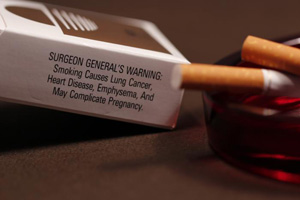
In 1964, Surgeon General Luther Terry issued a report in which he cited the health risks associated with smoking. That led to the passage of a new law requiring cigarette manufacturers to print a warning on every pack. In the 50 years since then, we’ve seen scientific revelations, massive litigation, fines and settlements; yet still, tobacco companies and the government continue to lock horns over the extent of damage that smoking can cause, and how best to rectify and prevent any further harm to consumers.
Whether planned or coincidental, last week’s anniversary of Terry’s landmark report was marked by two major developments. First, our current Surgeon General Boris Lushniak announced that in addition to causing lung disease and cancer, smoking also causes diabetes, rheumatoid arthritis, erectile dysfunction, macular degeneration, and liver and colon cancer.
The second development occurred six days earlier, when an agreement was reached in US District Court requiring tobacco companies to undertake a massive mea culpa. It will include admitting in print and broadcast ads that smoking is addictive, and that cigarette manufacturers manipulated nicotine delivery in their product so as to feed and better sustain that addiction. According to the Huffington Post’s Michael Felberbaum, the agreement (which follows a 2012 ruling ordering big tobacco to pay for corrective statements in advertisements) requires each of the companies to publish full-page ads in the Sunday edition of at least 35 newspapers and their respective websites. They must also air prime-time TV ads on ABC, CBS or NBC five times per week for a year, and print their transgressions on cigarette packs for the next two years.
These so called corrective ads must also be preceded with the statement that tobacco companies “deliberately deceived the American public,” and they must include the following statistics: Smoking kills more people than murder, AIDS, suicide, car crashes and alcohol combined, and that second-hand smoke kills over 38,000 Americans each year.
The affected companies are calling the corrective ads “forced public confessions… designed to shame and humiliate” them. If so, then that’s okay with the American Heart Association, American Cancer Society and American Lung Association, who released a joint statement saying that the ads are “necessary reminders that tobacco’s devastating toll over the past 50 years is no accident. It stems directly from the tobacco industry’s deceptive and even illegal practices.”
What strikes me about the latest health warnings and punitive actions is that it’s taken far too long for us to get to this point. Noted scientists Wyndren and Graham reported as far back as 1950 that 96.5 percent of lung cancer patients were heavy smokers. And in 1963, an in-house attorney for Brown & Williamson circulated a memo admitting that nicotine is addictive and that “we are in the business of selling nicotine — an addictive drug.”
Think of the lives that might have been saved had someone from B&W grown a pair 50 years ago, and blown the whistle on their manufacturing practices. That didn’t happen until 1996 when Jeffrey Wigand, a B&W researcher went public with confidential information about nicotine manipulation. Would people have still smoked had they known the real health risks and accelerated addictive properties of cigarettes early on? Probably, but they should have at least had access to the facts.
The other amazing thing about this 50-year saga is that no one in a position of leadership at the major tobacco companies has ever gone to prison. When the heads of the seven major cigarette makers testified on Capitol Hill in 1994, all seven men said under oath that nicotine is not addictive. The Waxman committee knew those CEOs were lying because six years earlier the surgeon general ruled that nicotine was, in fact, an addictive drug.
Yet no one went to jail for committing perjury. Let some poor slob off the street commit perjury in court and he goes to the slammer. Let some party perv spike a woman’s drink with a date rape drug, and he’ll get to see the inside of a jail. But let tobacco executives lie about spiking their product with a drug that has helped to kill millions of people, and their only punishment is to fund some foundations and run apology ads.
For eight years I watched my father die a little bit each day from COPD. He had been a heavy smoker for over 40 years, then managed to quit, and was smokefree for the last 20 years of his life. But it was too late. The damage to his lungs had been done. Tobacco company executives didn’t force my dad to smoke cigarettes, but we now know they did everything they could to make sure he kept smoking.
Thanks to cigarette makers and their addictive product, thousands of people live the last years of their lives in a sort of prison, tethered to oxygen tanks and wheelchairs. Meanwhile, tobacco bigwigs are living large, untethered, and complaining that having to finally (and publicly) tell the truth will somehow shame and humiliate them. Their feigned suffering would be laughable if my heart wasn’t so heavy.



 They make mistakes. But the mark of a great President is his willingness to admit when he’s wrong, and then to correct his mistake. No, I’m not talking about Barack Obama’s botched Affordable Care Act, and his broken promise to let everyone keep their existing health plan. I’m talking about John Kennedy, and how he misread history, unintentionally insulted the state of Virginia, and was compelled to make amends.
 The other day I read about a 52-year-old wife and mother who fulfilled her lifelong dream by trying out for and making the Dallas Cowboy Cheerleading squad. I suppose her story was inspiring on some level, and I’m not knocking anyone’s aspirations. I’m also probably the least qualified person in the hemisphere to comment on or criticize cheerleading. Nevertheless, we should all be concerned about the safety and impressionability of our children, and, by association, the relevance of the professional cheerleaders who they seek to emulate. Let’s begin with those NFL role models.
 In his address to a joint session of Congress on Sept. 9, 2009, President Obama outlined his vision for healthcare reform. At one point during his speech, the President was reassuring his audience that illegal immigrants would not be covered under the proposed Affordable Care Act (ACA), when he was rudely interrupted by South Carolina Congressman Joe Wilson who shouted, “You lie!” Those in attendance and many of us watching at home were appalled by Wilson’s behavior. After all, this was the President of the United States, and it is just not proper for anyone to interrupt him during a speech. I condemned Wilson at the time, and I still think his actions were inappropriate. But last week we learned that Obama deliberately misled Congress and the nation in order to gain passage of ACA, so now, I must regrettably admit that Mr. Wilson’s concerns were valid.
























Posted February 5, 2014 By Triad TodayAmericans Should Adopt Americans First
Since the late 18th century, America has been known as the world’s melting pot, so called because families immigrated here to seek a better life in a new home. Somewhere along the way, though, it became fashionable for Anglo- Americans to import their own multinational, multiracial families.
In recent times, for example, Angelina Jolie and other celebrities have been seen as humanitarians for their efforts to rescue at-risk children from Third World countries, as well as from more developed nations such as Russia.
It’s not surprising then, that advocates of foreign adoption, like Sen. Mary Landrieu of Louisiana, willingly supported the Hague Convention on Intercountry Adoption because the treaty would, according to the Associated Press, “establish ethical standards for international adoption.” But the Hague treaty had the opposite effect on foreign adoptions from what Landrieu and others had anticipated. Commenting to the AP last week, Sen. Landrieu said, “When I helped to pass this treaty, it was everyone’s hope that the number [of foreign adoptions] would go up…. Instead, it’s down by 60 percent.” Landrieu is correct.
In 2004, Americans adopted 22,991 foreign children, but by 2012, that number had dropped to 8,668.
A Nov. 17, 2011 report by NPR’s Alan Greenblatt revealed the decline of foreign adoptions was due primarily to corruption, longer wait times, and closing of adoption centers. South Korea, China, Ethiopia, Guatemala and Russia have all scaled back on the number of children available for foreign adoption, while Romania has halted such adoptions altogether.
But Greenblatt also proffered another reason for the decline in adoptions: “There seems to be a consensus within international child welfare circles that orphans should be kept with their own families or communities, and adopted domestically.”
No matter the reasons for the decline in foreign adoptions, Sen. Landrieu decided that congressional action was needed to ensure the health and safety of orphans in other countries. And so, in September of last year, Landrieu introduced the Children in Families First Act, which has since garnered a modicum of bipartisan support in both chambers. Primarily the bill would encourage more Americans to adopt foreign children, but Landrieu also wants to create a new bureau inside the State Department that will focus exclusively on international child welfare. However, many in Congress as well as officials in the State Department aren’t too excited about creating more government bureaucracy.
Senator Landrieu’s efforts are noble and commendable, but they are neither fair nor practical. As a mother of two adopted children, she is blinded by her own compassion for foreign orphans, and that’s okay for her. But legislation driven by that blind compassion may not be best for our nation as a whole. Depending upon which source you cite, there are currently about 3 million orphans in the United States. How, then, in good conscience can any American adopt a Russian or Ethiopian child, when 3 million children need homes right here in America?
I am reminded of a line from the film The American President in which an overzealous politician is described as “someone who claims to love America, but clearly can’t stand Americans.” The analogous reference is harsh and not directed at any of the 200,000 American parents who have given good homes to foreign orphans over the past 15 years.
But going forward, the last thing we need is a new law and a new bureaucracy that favors international orphans over their American counterparts. If such a government structure is put into place, then we are relegating our own American-born orphans to permanent second-class status, and signaling to them that they must continue to take a back seat to foreign kids when it comes to placement.
For now, we should accept the standards that have been established, respect the wishes of governments that want to curtail the export levels of children in their respective countries, and allocate whatever resources we can here in America to placing our own orphans in good homes.
Sen. Landrieu herself said it best:
“Every child needs and deserves to grow up in a family.”
There are three million American orphans who couldn’t agree with her more.