


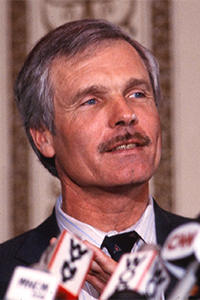
Over the past few decades, I’ve had to write far too many obituary columns. Most of them have paid tribute to celebrities whom I had become friends with and could write about from personal experience. In that regard, this column is decidedly different because I never knew, met, or spoke with Ted Turner. He did, however, send me some checks at a time in my life when I needed all the work I could get, so I guess that gives me the right to honor his passing. Ted Turner died last week at the age of 87.
Robert Edward Turner III was born on Nov. 19, 1938, in Cincinnati, Ohio, to Florence Rooney and Robert Turner II.
Ted’s father owned Turner Advertising, a successful Atlanta-based billboard company, which his son would later leverage into a media empire. Ted’s early holdings included radio and television stations in the Southeast, one of which was WRET in Charlotte. Another was Atlanta’s WTBS, which he morphed into the nation’s first true superstation.
But Ted’s most lasting contribution to the broadcast industry was his founding of Cable News Network. CNN’s first broadcast was on June 1, 1980, and that’s where my connection to Ted Turner began.
When CNN first launched, it had its headquarters in Atlanta with bureaus in New York City and Washington, D.C. Earlier that same year, I had started a video production company that specialized in producing local community affairs TV programs and video news releases. The VNR’s were most often paid for by companies that hired me to report on one of their new products or public service projects, and then to distribute those stories to TV stations around the country. My relationship with CNN was a win/win for both of us because they needed content, and that gave me an international outlet for my VNRs. I also needed to pick up jobs wherever available, and CNN needed freelance reporters and video crews to augment their full-time staff.
Some of the hard news packages that I sent to CNN included a report on Life Sciences’ illegal dumping of toxic Kepone into the James River, which caused neurological disorders in humans and untold damage to the environs. Another story that I reported on was A.H. Robins’ Dalkon Shield, a birth control device that was later banned from use in the United States. Other stories were political in nature, including my coverage of Ronald Reagan’s 1980 run for the White House. And then there was the time that CNN producer Jane Maxwell hired my crew to follow Prince Charles during his historic visit to Williamsburg in 1981, just two months prior to his nuptials with Diana. I was shoulder to shoulder with Britain’s future king for an entire day, and though our video turned out spectacularly, I came away with no still photos for my personal collection because I had forgotten to reload film in my camera. I think Ted might have laughed at that.
In those early days, news crews from ABC, CBS, and NBC would make fun of me and my CNN microphone flag as I pushed my way through their sacred circle to ask a question of a national news figure. After all, the big three networks each spent about $300 million dollars per year just to produce a daily half-hour newscast, while Ted had cobbled together a mere $34 million dollars to create CNN. Broadcasters and critics alike didn’t consider Uncle Ted’s venture to be a legitimate news operation and didn’t think it would last. Boy, were they wrong. CNN was the world’s first global, 24-hour news service, and it changed the face of broadcast journalism forever, breaking the mold of once-daily half-hour newscasts and giving rise to a host of other round-the-clock cable news channels.
Ted would go on to create the Turner Classic Movies channel, where he could showcase his vast film library, and he purchased a number of sports franchises, including the Atlanta Braves and Atlanta Hawks. But Ted’s crowning achievement was CNN, which gave viewers better access to news, made them more informed about the world around them, and generated public discourse that would help to shape important public policy initiatives.
There are a number of men and women who helped to develop and shape the television industry. Names like Sarnoff, Paley, Berle, Ball, Warner, and Spelling come to mind. But if I were to select a Mount Rushmore of TV, there are two people who most certainly would have to be included. One is Philo Farnsworth, who invented television with the hope that it would be used to inform and educate people. The other is Ted Turner, who made Farnsworth’s dream come true on a global scale. We all owe Ted Turner a debt of gratitude, and I owe him for helping me pay off some debt. Thanks for the paychecks, Ted.


































Posted May 19, 2026 By Triad Today(Way Past) Time for Foxx to Retire
Last week, a 10-year-old boy was bullied, not by another student online, but by an adult writing on official government stationery. The boy is Christian Mango, a fourth grader at Canterbury School in Greensboro. The bully is 82-year-old Virginia Foxx, an 11-term Congresswoman serving North Carolina’s fifth district, who represents some 750,000 people, including young master Mango.
Here’s how it all went down. Christian was given a school assignment in persuasive writing, so he elected to write his Congresswoman to persuade her to support a $5,000 tax rebate for anyone who purchases a new electric vehicle.
Instead of saying how impressed she was with his concern for the environment, Foxx criticized Christian’s teacher for spreading propaganda. Her malicious missive didn’t stop there. Wrote Foxx, “My guess is that your teachers will not give you a good educational experience and help you learn to think, as they are too interested in indoctrinating you.”
What the f**k, Virginia?! We’re talking about a 10-year-old child, not someone at the EPA who just leaked government secrets to the Russians. This boy did nothing to disparage or attack you. He just wanted to engage you in a dialogue about a policy issue.
I don’t know Christian Mango, but it turns out that I do know about being 10 years old and writing something I thought was important. It was 1964, and my Cub Scout leader encouraged me to enter the Freedom Foundation’s annual essay competition. The theme of my paper was “Why I Love America.” Imagine my surprise when I received word that I had won. The award consisted of a bronze medallion with my name inscribed right under a profile of George Washington. I was on cloud nine because my parents, teachers, and scout leader all bragged on me. That’s how adults are supposed to act when a 10-year-old boy takes the initiative to write about his beliefs. Without that kind of positive reinforcement, a kid could become discouraged. Virginia Foxx should know that because she used to be a teacher.
Ms. Foxx appeared on my television show a number of times back when she was still new to the Washington scene. In those days, we got along quite well, so much so that in 2005, she presented a resolution to Congress that recognized Triad Today for our commitment to voter education. Interestingly enough, she also used that occasion to praise the news media for the crucial role it plays in society. It was a grand gesture from a woman who began her political career as a hard-working advocate for her constituents. Her tireless efforts in that regard harkened back to her youth when she worked part-time as a school janitor in order to help support her family. Somewhere along the way, though, Virginia morphed into a very angry person who is increasingly given to rude outbursts when anyone asks or says something that she doesn’t like.
Three years ago, I wrote a column titled “Time for Foxx to Retire”. In that article, I recounted how she had frightened senior citizens away from supporting the Affordable Care Act by telling them that Obama intended to establish “death camps” for older people. She once called the brutal murder of Matthew Shepard a hoax. She defended the actions of insurrectionists on Jan. 6 and, right afterward, threw a temper tantrum when asked to walk through metal detectors leading to the House Chamber. Two years ago, when fellow Republican colleague Byron Donalds was speaking with reporters, Foxx yelled at him, saying, “Get away from the damned elevator. Move!” And her bullying ways were also on display at an impromptu press conference for newly elected House Speaker Mike Johnson. On that day, a reporter from ABC News asked Johnson about his role in trying to overturn the 2020 election. But before the affable Johnson could even respond, Foxx pushed her way in front of the gaggle and shouted to the reporter, “Shut up! Shut Up!” This from a woman who once praised the fourth estate as a “guardian of democracy.”
Obviously, my column back in 2023 did not persuade Ms. Foxx to retire, but perhaps widespread negative reaction to her exchange with Christian Mango will succeed where I had failed. In fact, last week, Michael Garrett, who represents Guilford County in the state legislature, called on Foxx to resign. Writing on Facebook, Garrett said, “You do not slam the door on a child reaching for democracy…a child wrote you a letter…and you called his teachers liars. That is not policy disagreement. That is a loss of soul. It is time to go.”
For what it’s worth, I second that sentiment. First, because I know what it feels like to be a 10-year-old boy seeking validation from adults, and second, because as Capt. Woodrow Call said in “Lonesome Dove,” “I can’t stand rude behavior.” Virginia, I don’t know why you have become so angry and so intolerant, but at this point, I really don’t care. To quote Debbie Harry, “Don’t go away mad, just go away.”