


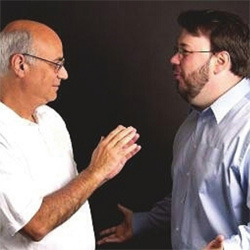
There have been some memorable comedy duos in the history of radio, among them, Burns and Allen, Abbott & Costello, and Bob & Ray. But even those broadcasting giants never attempted to augment their comedy bits with discussions about topical issues.
That’s what makes Brad Krantz and Britt Whitmire so unique. In one breath they can imply that Rush Limbaugh eats spotted owl sandwiches, and in the other, have a serious conversation about immigration. Now they have taken their satirically terrestrial act into cyber space, with a daily podcast, appropriately titled, “The Brad & Britt Show”.
Brad and Britt teamed up ten years ago with a morning show on Curtis Media’s WZTK, FM 101.1. Not only was their mixture of humor and discourse groundbreaking, so was their impact. That’s because WZTK’s signal stretched from Greensboro to Raleigh, which allowed the duo to develop a huge and diverse following in both the Triad and the Triangle markets. Theirs was simply the best radio show I had ever listened to. I laughed at them, and I learned from them.
But after eight successful years, B&B lost their venue when Don Curtis made the most boneheaded move in the history of local radio. He changed WZTK’s format from intelligent talk to salsa music. Meanwhile, just down the road in Charlotte, WBT was growing weary of their Tea Party programming, so they hired the boys to attract an audience that possessed actual grey matter between their ears. Once again Brad & Britt were a success, but, after two years, WBT decided not to renew their contract. Fortunately for their fans, B&B re-surfaced less than a month later with a podcast.
I got to know Brad and Britt from their appearances on my Triad Today TV show, and we’ve kept in touch ever since. Last week we had an extended telephone conversation about their career together and their new show, which after only four days, has placed in the top 200 among thousands of podcasts. Why am I not surprised.
JL: I know you guys have been together for ten years, but are you actually married to each other?
BW: No, I can do way better than Brad (laughter).
JL: Let’s go back to the WZTK debacle two years ago. Why would Curtis blow up a successful format?
BK: Radio stations and broadcast companies are not operated at the highest level of competency, so sometimes you can be a ratings success and artistic success, and if the ownership doesn’t know how to translate that into sales and financial success, then it really doesn’t matter.
JL: So Curtis didn’t know how to sell and market your unique show?
BW: They never tried.
BK: And still we owned the I-85 corridor with a very diverse audience across both markets. We were more liberal than the right wing sewer that passes for talk radio these days.
JL: Yet you left WZTK and went to work for WBT which wallowed in the right wing sewer.
BW: That’s because WBT pitched this to us as a grand opportunity. They wanted to turn a new page because their listeners were literally dying right before their eyes. They knew they had to try something different.
JL: And by all accounts, you guys delivered, yet they didn’t renew your contracts. Why?
BW: They lost their nerve about two days in, for whatever reason. They never really told us why.
JL: So now you’re podcasting. For those of us who are technology challenged, tell me what podcasting is.
BW: It’s radio without the bullshit (laughter).
BK: POD is an acronym for “programming on demand.”
BW: It’s where the suits don’t get to decide when you get to listen to a show. You can listen to a show whenever you want. Consumers now have unprecedented power to support programming they enjoy.
JL: Is your show live at some point during the day, or is it taped?
BW: It’s recorded, but you can listen anytime, just go to BradandBritt.com.
BK: We’re aiming to have each day’s show up by 3pm every afternoon.
(At this point, Brad and I lost our connection with Britt who returned to the phone after about two minutes.)
BK: What, did you get a better offer?
BW: Yeah, Jennifer Lopez just called me.
JL: How does your show actually become a podcast?
BW: We send the hour show to the Relm Network, then they post it on the website, and to iTunes. And then it propagates out to everybody. If you subscribe to iTunes, you’re automatically ready to rock and roll.
JL: Since your show is taped, you obviously won’t be able to take calls from listeners as you did on your radio show.
BK: Right, but they can communicate with us through our Facebook page.
JL: What about interviews with newsmakers?
BK: We can’t take incoming calls because we’re not live, but we can make outgoing calls and put them on the show. We’re not doing that the first couple of weeks, but we’ll start to integrate them into the show.
JL: And since you’re not on radio now, the FCC has nothing to say about your content, right?
BW: Right. The only trouble we could get in, is if we slander somebody or incite a riot.
JL: How are you doing with attracting sponsors?
BW: We’re already meeting with a number of sponsors.
BK: And we have a namesake for the studio. It’s called the TarheelDentist.com studio, courtesy of Dr. Mark Hyman.
BW: Mark told us, “Whatever you need, I want to support you guys”.
JL: Do you think you would ever go back to radio?
BW: My hope with the podcast, is that we will turn down radio offers because this is going too well. Right now, radio continues to help us out day by day, by getting worse and worse. The funny thing is, radio could be promoting itself and using this podcast technology as a huge weapon, but they don’t. It’s insane.
JL: So all we have to do to listen to you guys 24/7 is to turn on our computer, or iPhone, or connect in the car with blue tooth.
BK: It’s all us, all the time.
JL: One final thing. Are you afraid that some people will get confused and think you’re doing a show on “pot”? (laughter)
BK: Well actually in Colorado they are called “Potcasts”.
And as we all know, potcasts make you hungry. Anyone for spotted owl sandwiches?


 I first met Nancy Stafford at the Western Film Fair where she and I spoke about the passing of her Matlock co-star Andy Griffith. Nancy has returned to North Carolina several times since then, including making personal appearances in Mt. Airy. It’s appropriate that she has donated a handbag to this year’s auction, which is being held in Andy’s hometown.
 Speaking of hometowns, Anna Wood was born and reared in Surry County, and her Mom, Mary Beth works at the Woltz Hospice Home. Anna was a big hit in Deception, and can be seen this fall starring in the CBS crime drama, Reckless.
  The former Miss America had played Catwoman to Adam West’s Batman, she was also a scientist in The Time Tunnel, and she portrayed Buddy Ebsen’s daughter-in-law on Barnaby Jones. The year after our Hollywood event, Lee happened to be shooting a movie in Winston-Salem, so she, and my wife Pam and I spent a wonderful evening together. During the course of our dinner conversation, Lee told Pam she needed to buy some underwear, so the next day, the two women went shopping for unmentionables. I was not invited to come along. And what kind of purse has Lee donated to this year’s auction? A leather one, of course. Catwoman wouldn’t have it any other way.
 Mad Men is set in the 1960’s, so I asked Matt if one of his actresses might consider donating a purse. His reply was immediate. “How soon do you need them?” he said. A few days later, not one, but two purses arrived at my doorstep. One was from Elisabeth Moss, who plays Peggy on Mad Men, and the other came from
 Jessica Paré, who plays Jon Hamm’s wife Megan. Even better, the handbags were actually carried by Jessica and Elisabeth in several episodes of the EMMY award winning drama. The episode numbers are tagged on the purses, making them particularly valuable as collectibles.


 Years later the first TV appearance I did was on Gunsmoke, and being on that sound stage was like playing make-believe in the back yard.
 PS: It was 1976, I had graduated from college and was about to start the graduate business program at NYU, when I was asked to come out to Los Angeles and audition for The Hardy Boys. Shaun (Cassidy) was already set and I was the last person to read. They sort of matched us up together and it was a good combination. We loved working together, we worked easily together. We had fun together. We were sort of different, so it was nice.
 Following The Hardy Boys run, Parker was in demand as a guest star on a number of TV series including The Love Boat and Murder She Wrote. In 1986 he landed the role of Union officer Billy Hazard in the mini series North & South: Book Two, in which he worked with his wife Kirstie Alley, who played his sister in the film. North & South also gave the young actor another chance to ride horses and shoot guns. But for Parker, appearing in a Civil War drama had special meaning.
 JL: How did you get the role of Craig Pomeroy on Baywatch?
 Parker continued acting after Baywatch,but increasingly his interests turned to still photography, and forming his own company, Shadow Works.
 PS: I realized this last couple of weeks how much I missed acting. I love it. I love the process. But I love directing too because it lets me put people in the right configuration, with the right camera position and lens and lighting, and make things look ideally the way they should be. That’s also why I love photography, plus there’s no one re-editing what I shoot (laughs).

























Posted July 23, 2014 By Triad TodayArchie Andrews (1941-2014) R.I.P.
Those of us who have lost a loved one are not prone to mourn mundane things like the cancellation of our favorite TV show, or the playoff loss of our favorite team. Still, any abrupt change to the underpinnings of our little corner of the universe can serve to exacerbate our sensitivity over real life losses. For example, the death of my Mom came on the heels of the razing of my elementary school which used to stand just up the street from our old house. Taken separately, the building demolition would have seemed unimportant, but taken in tandem with my mother’s passing, it took on a different significance. The fact is we become easily attached to and sentimental over inanimate objects because they represent direct or collateral symbols of order and stability in our lives. And that brings me to comic books, and to the characters who appear in them.
For many of us, comic books were the first thing we read on our own for pleasure. They are something WE selected, something we purchased with our own money. Thus, those comics became part of the fabric of our childhood. The guys in my old neighborhood played sports together, fought together, played army together, and every Thursday, we rode our bikes down to Andrews Pharmacy and bought comic books together. Each of us had our favorites. One guy was all about Superman, another loved the Avengers. I collected The Flash for pure escapism, Dennis the Menace because he was my alter ego, and Archie, because I wanted to know what high school kids were like, and to see if Betty and Veronica would ever have a wardrobe malfunction.
Archie and his pals took me to Christmas parties, proms, ball games, and even to the 1964 World’s Fair. Archie comics were my pop culture preparatory school, and even as I got older, I loved the fact that Archie never aged. His creators, Vic Bloom and Bob Montana, knew that the key to a successful comic book character was to make him endearing and enduring, by having him reside in a kind of Neverland where he couldn’t grow old or die. Apparently the current publisher and co-CEO of Archie comics, Jon Goldwater, didn’t get the memo on that template, because for the past several years, he has turned Riverdale into a socio political laboratory of the worst kind.
Not only did Goldwater allow Archie and company to mature, he even let some of them get married. That includes a storyline where Archie tied the knot, and another where his gay pal Kevin entered into an interracial, homosexual union. Hey, I’m all for marriage of any kind, but not in high school, and that’s where all these folks should have been, not out in the real world being politically correct. OK, so Mr. Goldwater damaged the franchise by letting everyone get older, but last week he went too far, and allowed Archie to be killed off.
It seems that Kevin, a newly elected Senator, was crusading against gun violence when an assassin took a shot at him. Archie stepped into the path of the bullet, and the next thing we see is Betty and Veronica kneeling over Archie’s blood-soaked body in an eerie recreation of the RFK assassination. Goldwater tried to rationalize his idiotic decision in a public statement:
“The way in which Archie dies is everything you would expect of Archie. He dies heroically. He dies selflessly. He dies in the manner that epitomizes not only the best of Riverdale, but the best of all of us.”
Pardon me while I heave at that hypocrisy. Goldwater doesn’t care about heroism, he only cares about the immediate bottom line, because sales of his revamped Archie comics have been on the decline. According to the Weekly Standard’s Jonathan Last, the previous issue of “Life With Archie” only sold 2,064 copies. Said Last, “The stunt (Archie’s death) is perfectly in line with a company that’s experiencing massive internal turmoil.”
Perhaps some stunts are harmless, after all, everyone knew that Superman wasn’t really dead when DC Comics killed him off in 1992. But Archie is not a regenerating super hero. He is just flesh and blood (sort of),and now he’s been felled by an assassin’s bullet. And since Archie died fighting for a political issue like restrictions on handguns, cartoonist Rick McKee of the Augusta Chronicle has sarcastically proposed a number of other death scenarios for the Archie gang. McKee predicts that Jughead will die while trying to save a Polar Bear from drowning in a rising sea caused by global warming. He also says Betty will perish in a botched back alley abortion because her boss at Hobby Lobby wouldn’t spring for morning after pills.
If Goldwater had wanted to sell comics with sensationalistic political correctness, he could have simply kept the kids in high school, and let them lobby for or against various causes. There was no need to have Peter Pan grow up and get killed just to enrich pirate Goldwater’s booty.
I am reminded of a line from the film “Brubaker” in which a corrupt vendor tries to bribe the prison warden. When the warden refuses the bribe, the vendor says, “It’s tradition. Don’t f**k with tradition.”
Jon Goldwater f**ked with tradition, and now Archie is dead, and a part of every baby boomer fan has died too. Shame on Goldwater for sullying our childhood memories, and causing an unnecessary death in the family. Shame on him for f**king with tradition.