
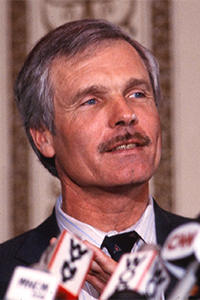
Over the past few decades, I’ve had to write far too many obituary columns. Most of them have paid tribute to celebrities whom I had become friends with and could write about from personal experience. In that regard, this column is decidedly different because I never knew, met, or spoke with Ted Turner. He did, however, send me some checks at a time in my life when I needed all the work I could get, so I guess that gives me the right to honor his passing. Ted Turner died last week at the age of 87.
Robert Edward Turner III was born on Nov. 19, 1938, in Cincinnati, Ohio, to Florence Rooney and Robert Turner II.
Ted’s father owned Turner Advertising, a successful Atlanta-based billboard company, which his son would later leverage into a media empire. Ted’s early holdings included radio and television stations in the Southeast, one of which was WRET in Charlotte. Another was Atlanta’s WTBS, which he morphed into the nation’s first true superstation.
But Ted’s most lasting contribution to the broadcast industry was his founding of Cable News Network. CNN’s first broadcast was on June 1, 1980, and that’s where my connection to Ted Turner began.
When CNN first launched, it had its headquarters in Atlanta with bureaus in New York City and Washington, D.C. Earlier that same year, I had started a video production company that specialized in producing local community affairs TV programs and video news releases. The VNR’s were most often paid for by companies that hired me to report on one of their new products or public service projects, and then to distribute those stories to TV stations around the country. My relationship with CNN was a win/win for both of us because they needed content, and that gave me an international outlet for my VNRs. I also needed to pick up jobs wherever available, and CNN needed freelance reporters and video crews to augment their full-time staff.
Some of the hard news packages that I sent to CNN included a report on Life Sciences’ illegal dumping of toxic Kepone into the James River, which caused neurological disorders in humans and untold damage to the environs. Another story that I reported on was A.H. Robins’ Dalkon Shield, a birth control device that was later banned from use in the United States. Other stories were political in nature, including my coverage of Ronald Reagan’s 1980 run for the White House. And then there was the time that CNN producer Jane Maxwell hired my crew to follow Prince Charles during his historic visit to Williamsburg in 1981, just two months prior to his nuptials with Diana. I was shoulder to shoulder with Britain’s future king for an entire day, and though our video turned out spectacularly, I came away with no still photos for my personal collection because I had forgotten to reload film in my camera. I think Ted might have laughed at that.
In those early days, news crews from ABC, CBS, and NBC would make fun of me and my CNN microphone flag as I pushed my way through their sacred circle to ask a question of a national news figure. After all, the big three networks each spent about $300 million dollars per year just to produce a daily half-hour newscast, while Ted had cobbled together a mere $34 million dollars to create CNN. Broadcasters and critics alike didn’t consider Uncle Ted’s venture to be a legitimate news operation and didn’t think it would last. Boy, were they wrong. CNN was the world’s first global, 24-hour news service, and it changed the face of broadcast journalism forever, breaking the mold of once-daily half-hour newscasts and giving rise to a host of other round-the-clock cable news channels.
Ted would go on to create the Turner Classic Movies channel, where he could showcase his vast film library, and he purchased a number of sports franchises, including the Atlanta Braves and Atlanta Hawks. But Ted’s crowning achievement was CNN, which gave viewers better access to news, made them more informed about the world around them, and generated public discourse that would help to shape important public policy initiatives.
There are a number of men and women who helped to develop and shape the television industry. Names like Sarnoff, Paley, Berle, Ball, Warner, and Spelling come to mind. But if I were to select a Mount Rushmore of TV, there are two people who most certainly would have to be included. One is Philo Farnsworth, who invented television with the hope that it would be used to inform and educate people. The other is Ted Turner, who made Farnsworth’s dream come true on a global scale. We all owe Ted Turner a debt of gratitude, and I owe him for helping me pay off some debt. Thanks for the paychecks, Ted.
























Ted Turner: Passing of a TV Pioneer
Over the past few decades, I’ve had to write far too many obituary columns. Most of them have paid tribute to celebrities whom I had become friends with and could write about from personal experience. In that regard, this column is decidedly different because I never knew, met, or spoke with Ted Turner. He did, however, send me some checks at a time in my life when I needed all the work I could get, so I guess that gives me the right to honor his passing. Ted Turner died last week at the age of 87.
Robert Edward Turner III was born on Nov. 19, 1938, in Cincinnati, Ohio, to Florence Rooney and Robert Turner II.
Ted’s father owned Turner Advertising, a successful Atlanta-based billboard company, which his son would later leverage into a media empire. Ted’s early holdings included radio and television stations in the Southeast, one of which was WRET in Charlotte. Another was Atlanta’s WTBS, which he morphed into the nation’s first true superstation.
But Ted’s most lasting contribution to the broadcast industry was his founding of Cable News Network. CNN’s first broadcast was on June 1, 1980, and that’s where my connection to Ted Turner began.
When CNN first launched, it had its headquarters in Atlanta with bureaus in New York City and Washington, D.C. Earlier that same year, I had started a video production company that specialized in producing local community affairs TV programs and video news releases. The VNR’s were most often paid for by companies that hired me to report on one of their new products or public service projects, and then to distribute those stories to TV stations around the country. My relationship with CNN was a win/win for both of us because they needed content, and that gave me an international outlet for my VNRs. I also needed to pick up jobs wherever available, and CNN needed freelance reporters and video crews to augment their full-time staff.
Some of the hard news packages that I sent to CNN included a report on Life Sciences’ illegal dumping of toxic Kepone into the James River, which caused neurological disorders in humans and untold damage to the environs. Another story that I reported on was A.H. Robins’ Dalkon Shield, a birth control device that was later banned from use in the United States. Other stories were political in nature, including my coverage of Ronald Reagan’s 1980 run for the White House. And then there was the time that CNN producer Jane Maxwell hired my crew to follow Prince Charles during his historic visit to Williamsburg in 1981, just two months prior to his nuptials with Diana. I was shoulder to shoulder with Britain’s future king for an entire day, and though our video turned out spectacularly, I came away with no still photos for my personal collection because I had forgotten to reload film in my camera. I think Ted might have laughed at that.
In those early days, news crews from ABC, CBS, and NBC would make fun of me and my CNN microphone flag as I pushed my way through their sacred circle to ask a question of a national news figure. After all, the big three networks each spent about $300 million dollars per year just to produce a daily half-hour newscast, while Ted had cobbled together a mere $34 million dollars to create CNN. Broadcasters and critics alike didn’t consider Uncle Ted’s venture to be a legitimate news operation and didn’t think it would last. Boy, were they wrong. CNN was the world’s first global, 24-hour news service, and it changed the face of broadcast journalism forever, breaking the mold of once-daily half-hour newscasts and giving rise to a host of other round-the-clock cable news channels.
Ted would go on to create the Turner Classic Movies channel, where he could showcase his vast film library, and he purchased a number of sports franchises, including the Atlanta Braves and Atlanta Hawks. But Ted’s crowning achievement was CNN, which gave viewers better access to news, made them more informed about the world around them, and generated public discourse that would help to shape important public policy initiatives.
There are a number of men and women who helped to develop and shape the television industry. Names like Sarnoff, Paley, Berle, Ball, Warner, and Spelling come to mind. But if I were to select a Mount Rushmore of TV, there are two people who most certainly would have to be included. One is Philo Farnsworth, who invented television with the hope that it would be used to inform and educate people. The other is Ted Turner, who made Farnsworth’s dream come true on a global scale. We all owe Ted Turner a debt of gratitude, and I owe him for helping me pay off some debt. Thanks for the paychecks, Ted.