
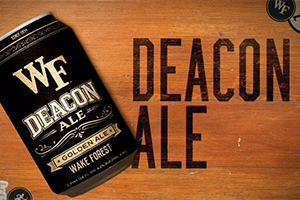
Earlier this month, Wake Forest University head football coach Jake Dickert and Lost World’s Brewery founder Dave Hamme held a press conference to announce that a new incarnation of Deacon Ale would soon be available at Lowe’s Foods and at Allegacy Stadium during Wake home games. The Deacon mascot was also on hand because it’s his image that appears on each can of ale, along with an illustration of Wait Chapel, both reminders of the university’s Southern Baptist heritage. Given that heritage, it would be easy to take a cheap shot at the irony and hypocrisy of a drinking Deacon, but the more significant issue has to do with making the beer seem attractive to young people who support and follow Wake football. Said Dickert, “Our fans need to get on board with this.” His was an innocent enough statement, but one that is inherently fraught with caution.
Here in North Carolina, it is illegal for anyone under the age of 21 to purchase, possess, or consume alcoholic beverages. So, what then is the problem with the manufacture of Deacon Ale? First, thanks to studies by the Center for Science in the Public Interest (CSPI) dating back over two decades, we know that the majority of Americans think it is wrong for colleges to take money from beer companies. More importantly, survey respondents also believe that beer companies deliberately use sports to reach, influence, and advertise to persons under the legal drinking age. It’s much like when, in 1923, 26-year-old Paul Perritt was asked why he robs banks. Perritt replied, “Because that’s where the money is.” At the very least, marketing beer via college sports is a legal way of nurturing future customers, but despite state laws, young people under 21 have ready access to beer now and are already consuming it.
According to a 2024 National Survey on Drug Use and Health conducted by NIH, nearly 33% of young people (12.7 million) ages 12 to 20 report that they have consumed an alcoholic beverage. 27% (10.4 million) say they drank in the past year, 13% (3 million) within the past month, and 8% reported recent binge drinking. And according to the CDC, 29% of young people aged 15 to 20 who are killed in motor vehicle crashes have been drinking.
The problem of underage drinking and alcohol use among young adults is not just reflected in national statistics. The problem hits closer to home as I learned from a recent conversation with Michael Duncan, director of Forsyth County Behavioral Services.
JL: Why do you say alcohol abuse is a public health issue?
MD: One in two Americans drink alcohol. Unlike opioid abuse, it is socially accepted, and it’s readily available.
JL: How much of a problem is alcohol abuse in Forsyth County?
MD: In 2024, we had 1,741 overdose cases. Of those, 1,583 were alcohol related.
JL: Are alcohol overdoses as dangerous as drug overdoses?
MD: They are often more dangerous and for a lot of reasons. One is they often build up a tolerance to alcohol; then they drink more to get the same effect, and that can lead to alcohol poisoning, which is deadly.
JL: Are certain age groups more susceptible to alcohol abuse?
MD: As we said, alcohol is readily available, and now we’re seeing a rise in binge drinking among young people, college-age, and even high schoolers. They taste alcohol and they drink too much because they don’t know their limit.
Duncan’s assessment is backed up by NIH and CSPI research. Currently, 7.2 million college students are binge drinkers, and 44% of students attending a four-year college drink at binge levels. Moreover, each year over 1,800 college students die from alcohol-related unintentional injuries, and 150,000 develop an alcohol-related health problem. Aside from individual health risks, there’s also collateral damage resulting from underage drinking. Nearly 100,000 college students are victims of alcohol-related assault or date rape. 25% of all college students have academic problems due to alcohol use, including missing class and receiving poor grades. And, according to Penn State professor Jeff Hayes, students who are binge drinkers suffer with depression and anxiety and are more suicidal.
All of this suggests that it’s probably not a good idea for colleges and universities to promote and encourage drinking, much less profit from selling their own brand of beer.
Some say that drinking alcohol is a rite of passage, but perhaps the time has come for us to take a prohibitive stand on college drinking as a way of preventing alcohol-related problems. The rite of passage is one thing. The right to pass out is another.























What’s Wrong With Deacon Ale?
Earlier this month, Wake Forest University head football coach Jake Dickert and Lost World’s Brewery founder Dave Hamme held a press conference to announce that a new incarnation of Deacon Ale would soon be available at Lowe’s Foods and at Allegacy Stadium during Wake home games. The Deacon mascot was also on hand because it’s his image that appears on each can of ale, along with an illustration of Wait Chapel, both reminders of the university’s Southern Baptist heritage. Given that heritage, it would be easy to take a cheap shot at the irony and hypocrisy of a drinking Deacon, but the more significant issue has to do with making the beer seem attractive to young people who support and follow Wake football. Said Dickert, “Our fans need to get on board with this.” His was an innocent enough statement, but one that is inherently fraught with caution.
Here in North Carolina, it is illegal for anyone under the age of 21 to purchase, possess, or consume alcoholic beverages. So, what then is the problem with the manufacture of Deacon Ale? First, thanks to studies by the Center for Science in the Public Interest (CSPI) dating back over two decades, we know that the majority of Americans think it is wrong for colleges to take money from beer companies. More importantly, survey respondents also believe that beer companies deliberately use sports to reach, influence, and advertise to persons under the legal drinking age. It’s much like when, in 1923, 26-year-old Paul Perritt was asked why he robs banks. Perritt replied, “Because that’s where the money is.” At the very least, marketing beer via college sports is a legal way of nurturing future customers, but despite state laws, young people under 21 have ready access to beer now and are already consuming it.
According to a 2024 National Survey on Drug Use and Health conducted by NIH, nearly 33% of young people (12.7 million) ages 12 to 20 report that they have consumed an alcoholic beverage. 27% (10.4 million) say they drank in the past year, 13% (3 million) within the past month, and 8% reported recent binge drinking. And according to the CDC, 29% of young people aged 15 to 20 who are killed in motor vehicle crashes have been drinking.
The problem of underage drinking and alcohol use among young adults is not just reflected in national statistics. The problem hits closer to home as I learned from a recent conversation with Michael Duncan, director of Forsyth County Behavioral Services.
Duncan’s assessment is backed up by NIH and CSPI research. Currently, 7.2 million college students are binge drinkers, and 44% of students attending a four-year college drink at binge levels. Moreover, each year over 1,800 college students die from alcohol-related unintentional injuries, and 150,000 develop an alcohol-related health problem. Aside from individual health risks, there’s also collateral damage resulting from underage drinking. Nearly 100,000 college students are victims of alcohol-related assault or date rape. 25% of all college students have academic problems due to alcohol use, including missing class and receiving poor grades. And, according to Penn State professor Jeff Hayes, students who are binge drinkers suffer with depression and anxiety and are more suicidal.
All of this suggests that it’s probably not a good idea for colleges and universities to promote and encourage drinking, much less profit from selling their own brand of beer.
Some say that drinking alcohol is a rite of passage, but perhaps the time has come for us to take a prohibitive stand on college drinking as a way of preventing alcohol-related problems. The rite of passage is one thing. The right to pass out is another.