


At a recent meeting of the Winston-Salem Forsyth County School Board, a number of concerned parents rose to speak in favor of making African American history a mandatory course of study. Said Destiny Blackwell, “If we’re not teaching Black history, we are complicitly allowing it to disappear.” I agree with Ms. Blackwell’s assessment, however, the problem isn’t that Americans don’t know much about Black history – the problem is that we don’t know much about ANY history.
In February of this year, the Woodrow Wilson National Fellowship Foundation (WWNFF) released the disturbing results of a new survey in which only 27% of folks under the age of 45 demonstrated a basic knowledge of American history. Of the 41,000 adults surveyed, only 15% knew what year our Constitution was written, and only 25% knew that free speech was protected by that great document. Said WWNFF President Arthur Levine, “Americans don’t possess the history knowledge they need to be informed and engaged citizens.” His conclusion comes as no surprise to those of us who have been tracking the problem for years.
In 2015, for example, Smithsonian.com’s Saba Naseem reported on a survey by Texas Tech University in which students were asked a series of basic history questions. Many respondents thought the South had won the Civil War, and hardly anyone knew who our vice president was. Naseem also re-hashed a 2014 study by the National Assessment of Educational Progress (NAEP), which found that a mere 18% of 8th graders “were proficient in US history.” Then there was the 2008 survey by the Intercollegiate Studies Institute which reported that only half of American adults could name the three branches of government. And if you really want to get depressed, then take a few moments to watch a video by PragerU.com, in which millennials were interviewed about their knowledge of American history. Asked who our 16th president was, hardly any of the respondents knew it was Abraham Lincoln. This is particularly disturbing because they were interviewed in front of the Lincoln Memorial which they had just visited.
As a graduate of the Winston-Salem Forsyth County school system, I am saddened that today’s parents are even having to lobby for an expanded history curriculum. Granted we’re talking 60 years ago, but by the time I was in third grade, I could name the three branches of government and knew that honest Abe was our 16th president. I knew about the educational and agricultural contributions of Booker T. Washington and George Washington Carver, respectively. And though I couldn’t recite the purpose behind all of its amendments, I knew that the Constitution allowed me the freedom to speak my mind.
Last week, a group of parents spoke their minds, and I hope that their words will resonate well beyond Forsyth County. No, I don’t think we need a mandatory course on Black history, or White history, or Asian history. Those are classes that can be offered on the post-secondary level. What we need, though, is a more comprehensive and inclusive American history curriculum beginning in the primary grades, and continuing on into high school. We simply can’t afford to turn out another generation of uninformed citizens.
























Posted May 14, 2019 By Triad TodayMy Picks for Best of the Triad
Since this week’s issue of Yes! Weekly is the annual Triad’s Best issue, Charles Womack, the publisher, asked me to add my two cents worth to the festivities. Here, in no particular order, are some of my picks for Triad’s Best, according to categories that often go overlooked:
Best Distillery: Old Nick Williams, where cousins Zeb and Matt Williams make Carolina Bourbon Whisley at the same farm in Lewisville as did their ancestor Joseph Williams back in 1768. The distillery was forced to shut down during Prohibition, but the Williams boys revived the operation several years ago. They have also preserved some interesting historic artifacts which are on display in the gift shop.
Best Garden: Paul J. Ciener Botanical Garden, located in historic downtown Kernersville, actually has 7 different gardens, including a tulip garden and a kitchen garden. Staff horticulturists conduct tours and offer planting tips year round. The garden has also become a popular site for weddings and receptions.
Best Sports Complex: Proehlific Park in Greensboro offers a wide variety of indoor athletic facilities in its 86,000 square foot complex, plus a number of outdoor sports in its 22-acre park. But it is also headquarters to Ricky and Kelly Proehl’s P.O.W.E.R. of Play Foundation which offers young people a structured environment for growing their minds and bodies. The Foundation will also soon start constructing the area’s first all-inclusive playground for kids of all ability levels.
Best Bakery: Winkler Bakery, the oldest continually operating bakery in America, has been baking cookies, bread and sugar cakes in Old Salem since George Washington’s day, and in the same oven. I dare you to try to make it home with a hot loaf of bread without sneaking a taste on the way. Bakery staff is dressed in authentic colonial garb, or at least I think that’s who I gave my credit card to.
Best Stretch of I-40: NONE. If you have to commute between Winston-Salem and Greensboro, it’s probably best if you charter an airplane. Speaking of which…
Best Directional Signage on the Way to PTI: NONE. It’s so confusing that I once ended up in Galax, which, by the way, doesn’t offer flights to Tampa.
Best Live Performance Theatre: High Point Theatre gets high marks for offering up a diverse selection of concerts and events, season after season. One week there’s a military band, the next, a country music singer or hip hop group. You might see TV and movie stars one night, and a local talent competition the next. Kudos to my friend Dave Briggs for booking something for everyone.
Best Movie Theatre: Although the Carolina Theatre in downtown Greensboro offers live concerts and lectures, it’s also the best place to see classic films come alive on a big screen for the first time in generations. Historic films like Frankenstein deserve to be shown in an historic theatre. It’s better than blu-ray.
Best Community Haunt: Woods of Terror is widely recognized as one of America’s best haunts, but owner Eddie McLaurin also offers seasonal events, like Easter egg hunts and a breath-taking Christmas light show. And, during the Halloween season, Eddie regularly offers up free thrills to special needs kids, while providing employment for hundreds of actors. All that from a guy with a giant boa constrictor wrapped around his neck.
Best Science Fair: This category goes to UNCG for its annual “Science Everywhere” event, where students and faculty get kids and parents excited about science. The event features campus-wide displays, demonstrations, and family activities.
Best Public Relations Agency: Pam Cook Communications. Why? Because Pam uses her TV news background to help non-profit organizations advance their mission of service to others. Also, because she’s my wife, and I had to mention her because I don’t feel safe at home.
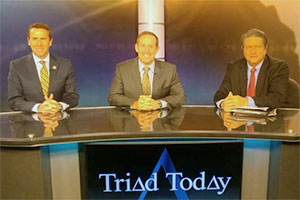
One last thing. For the past 10 years I’ve tried to get our communist publisher to create a category for “Best Locally Produced Public Affairs Television Program”, but he refuses because he says that Triad Today would be the only entry, since it’s the only locally produced public affairs television program in the Triad. I think that’s a lame excuse, so I’m going to move to Galax and write for their paper.