


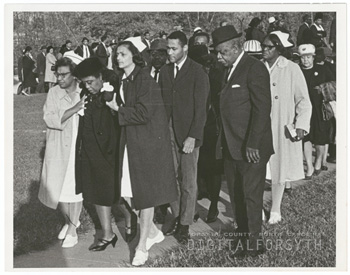
An unarmed black man was killed by a white police officer while resisting arrest. The details of the incident were withheld by police for over a week. Later, a judge dismissed murder charges against the cop, and riots ensued, including burning and looting. This wasn’t in Ferguson, Missouri in 2014. It was in Winston-Salem in 1967. I was 13 years old at the time, and I remember riding to church and seeing National Guardsmen positioned on tops of buildings throughout downtown Winston-Salem. The Guard was there to restore law and order, the practice of which, ironically, had caused the civil unrest to begin with. Here’s what happened.
On Oct. 15, 1967, James Eller, an African-American father of four, was seen staggering across a street. Mr. Eller made it to the front porch of his house where several police officers caught up with him, and proceeded to arrest him for alleged public drunkenness. According to police, Eller resisted arrest and the officers tried to subdue him, first by spraying MACE into his eyes. That didn’t work, so patrolman W.E. Owens struck Eller on the head with a blackjack. It proved to be a fatal blow. Police didn’t release details of Eller’s death until eight days later, and it was another four days after that before Owens was suspended. Eller’s widow swore out a warrant against Owens, which according to the Winston-Salem Journal stated that Owens, “feloniously, with premeditation, deliberation, and malice and forethought, did kill and murder one James Eller.” Judge Leroy Sams dismissed the case, and that ruling triggered riots in downtown Winston-Salem.
Winston-Salem Journal and Twin City Sentinel reporters Roy Thompson, Steve Burns, Gene Whitman, Joe Goodman, and Eugene White, and editor Wallace Carroll provided extensive coverage of the riots, which included descriptions of damage to stores along Liberty, North Trade, North Cherry, Claremont, Main, and Fourth streets. Most of the businesses were looted then burned. Mobs particularly targeted jewelry and liquor stores, as well as furniture and appliance stores. Fires broke out everywhere, cars were overturned, bricks were tossed, and shots were fired.
Patrolman E.W. Thorpe described the Nov. 2nd sniper fire to Eugene White in saying, “Guns were reporting everywhere, and you didn’t know who was shooting at who.” Thorpe’s own patrol car was struck by sniper fire at 13th Street and Patterson Avenues. His partner, C.E. Crosby, who fought in the Pacific during WW II, described the rioting as a “small scale war.” Said Crosby, “We didn’t know where to take cover when there was shooting. We were afraid we might try to take cover where the shooting was coming from.”
Mobs also set a fire just behind a Reynolds Tobacco factory on Chestnut Street. The fire was burning near a gas tank, and had Thorpe and Crosby not arrived in time to put it out, there probably would be no Innovation Quarter today.
Twin City Police Chief Tucker told his troops to “take things easy on the mob,” but, he added, “Pull out the heavy stuff. Don’t use it unless you have to, but display it. But STOP it.” Normally, local National Guardsmen are not called upon to defend their own city, but the 200-man Winston-Salem guard was put on alert. Meanwhile, Mayor M.C. Benton and Governor Dan Moore deployed National Guardsmen from Mt. Airy. Most of them patrolled the streets, while others were given roof-top duty. Two of them, Spec 4 Tommy Hennis and PFC Rodney Cooke were positioned atop the Robert E. Lee Hotel.
After a couple of days, all that remained of the “small scale war” were charred buildings and debris in the streets. Order had been restored without loss of life, but there were a number of injuries reported, including to a “negro woman” who had been hit in the head by a brick. Mobs, it seems, are indiscriminant about who they hurt.
The events of Oct. 15, and Nov. 2, 1967, taught us a lot about race relations, the criminal justice system, mobs, and the way Winston-Salem dealt with all of them. Officer Owens probably didn’t mean to kill Mr. Eller, but his unnecessary use of force triggered a firestorm nevertheless. Critics of the time said the officers on Eller’s front porch that fateful day should have used handcuffs instead of mace and nightsticks. The police chief should have gone public within hours of Eller’s death. Judge Sams should have meted out an appropriate punishment for officer Owens. And the rioters should have stayed home. Instead, most of them sought to inflict deliberate damage to local businesses, and some intended to kill cops. One member of a mob was overheard saying to a policeman, “I’m going to get one of you for this.” Burning, looting, and killing is not an appropriate or effective response to police brutality.
In an editorial, Wallace Carroll wrote, “We cannot permit ours to be a city where people are divided against each other by race, and where public safety cannot be taken for granted. No city in America is immune from the passions of these days. But we can overcome them here. We must.”
Late last month, a group of concerned citizens marched along Hanes Mall Boulevard in Winston-Salem to peacefully protest the August killing of Michael Brown at the hands of a white officer in Ferguson, Missouri. It reminded us that while we still have a long way to go to improve race relations, we’ve also made some progress over the past 47 years. Instead of throwing bricks and setting fires, last month’s protesters held up signs. Instead of threatening to kill cops, they sought substantive reform in our nation’s police departments.
Their protests are being heard.
Recently, Forsyth County Sheriff Bill Schatzman ordered body cameras for his deputies, which will usher in a new era of transparency. Hopefully, that will also start a trend throughout the Triad. We also need to be ever-vigilant about representative hiring in local police departments, something at which the town of Ferguson failed miserably.
There will always be rogue cops who break the law, and mobs who use those incidents as an excuse to do the same. But by and large I think the events of 1967 and 2014 demonstrate that Winston-Salem, to paraphrase philosopher George Santayana, has learned from the past, and is not condemned to repeat it.


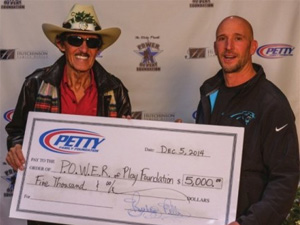
 Hutchinson: Every year we sit down and think about how we want to direct our charitable efforts, and we’ve already worked with Richard and his Foundation, and we learned about Ricky and his Foundation, and it just seemed like a good mix for us, and they fit well.





























Posted January 14, 2015 By Triad TodayBarbara Hall: Madam Multi Tasker
At a 1962 dinner honoring a group of Nobel Prize winners, President Kennedy observed, “I think it’s truly the most extraordinary collection of talent that has ever been gathered together at the White House, with the possible exception of when Thomas Jefferson dined alone.” It was JFK’s way of recognizing Jefferson’s exceptional talent and versatility. The same case could be made for another Virginia-born genius, my friend Barbara Hall, who once wrote a TV pilot about a female super hero that I’m convinced was autobiographical.
Barbara is the lead singer for a band, author of 11 novels, has been honored by the American Library Association, and was awarded the Humanitas Prize for her television writing. She’s also a lecturer, a dedicated Mom and one of the most successful producers of primetime dramas since the millennium began. Her writing and producing credits include Northern Exposure, I’ll Fly Away, Judging Amy, Joan of Arcadia, Homeland, and most recently, the critically acclaimed Madam Secretary, starring Tea Leoni.
“I was approached by Lori McCreary who runs Morgan Freeman’s company, Revelations Entertainment, and they had an idea to do a TV series about a female Secretary of State,” said Hall. “They had some story ideas, then I came in and fleshed out the show, and we developed it.”
Madam Secretary is Revelations’ first foray into television, and Freeman is pleased with the result. In an email to me, Morgan said of Barbara, “Lori and I have never had a more satisfying, rewarding, and delightful collaborator.”
I first met Barbara when she participated in my “Women in Drama” event for the Television Academy back in the fall of 2000. Last month we spoke by phone about Madam Secretary.
JL: You once told me that you only like to write shows that you would watch. Is that still true?
BH: That’s absolutely true, and sort of why I lay low for awhile, because there just wasn’t anything on the TV landscape that I would want to do or watch.
But then with Madam Secretary, suddenly there was room for a show that I would want to watch.
JL: As producer and show runner, how much writing are you getting to do on the series?
BH: A lot. I wrote the pilot and the first episode, and I wrote episode 14 which will air in February, and I’ll write the last one. But that’s sort of a tricky question because I’m involved in breaking all of the stories and overseeing the story meetings and scripts. I’d like to do more, but the problem is that writing a script takes you out of the loop on everything else.
JL: Television audiences have been dumbed down over the past couple of decades, feasting on shows like Jerry Springer and Honey Boo Boo. With Madam Secretary are you trying to elevate, educate and engage viewers to some degree, or do you just set out to entertain them?
BH: (laughs) Well I want to do both.
But I don’t think you should use the word “educate”, because it’s not school. It’s just that I wanted to work in an arena where there are a lot of interesting stories to tell about a world that people might not understand. And so, really sort of pull back the curtain is more our approach, and show people, because I’ve done the research, and I’ve been able to go into this world to reveal the aspects of government that they might not know about, and they might find interesting at the same time. And, we have a secret plan to entertain them (laughs).
JL: Not too many years ago, trying to get a political show on the air was almost impossible, and now they’re all over the place. Shows like House of Cards, Veep, Scandal, and State of Affairs. And they’re all doing well.
BH: I know, I think it’s cyclical. All that has to happen is for one or two shows to do well in a particular arena, and then it fits into the landscape. It’s not that everybody jumps on the bandwagon, but it’s that everybody has circled around these arenas all the time, and when one or two shows break and make it possible and OK, it gives everyone else permission to write a show now. So certainly I benefitted from that.
JL: Conspiracy nuts might accuse you of using Madam Secretary to bolster Hillary’s next Presidential campaign. How do you plead?
BH: (laughs) Well my comeback to that is there are so many easier ways to get Hillary elected President than to create a TV show about her (laughs). Our show has nothing to do with Hillary at all, but if people are still seeing her in the character, they’re going to have to answer for that. Tea’s character has nothing in common with Hillary except she’s a female Secretary of State, and she’s blonde. I saw that train leaving the station, but there was nothing I could do about it. If you really stop and weigh the conspiracy, though, it doesn’t make any sense. If people understood what it takes to get a TV show on the air, and what a long shot it is for it to be a success, they’d see it’s not a very practical approach to getting someone elected to office.
A long shot maybe, but not so difficult for a female super hero.
(Madam Secretary airs Sunday nights at 8:00 on CBS. Barbara’s music CDs are available from CDBaby.com and her novels are available through Amazon.com.)