
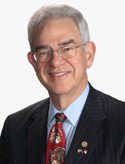
Don Martin is a numbers guy who gravitated to the study of mathematics early in life. He is the living embodiment of who we point to when a young student asks, “When will I ever use math in real life?” The fact is that Don has been a master of equations throughout his career in public service, but he always made numbers serve the human equation above all else, first as a teacher, then as superintendent, and finally as a county commissioner.
Don Martin grew up in Athens, Georgia, and his future career path was informed by a mother who taught school and a father who was a sales engineer with Gulf Oil Corporation. That combination of role models served him well as he matriculated through Duke University, where he majored in physics and obtained a Masters of Arts in Teaching. He then attended the University of Kentucky, where he received a doctorate in Educational Administration.
Don’s first teaching job came at Wilkes Central High School, where he taught math and physics for four years. After leaving U.K., he served as superintendent of two different Kentucky school districts before heading up the newly-formed Rowan-Salisbury school system. In 1994, he was tapped to lead the Winston-Salem/Forsyth County Schools, where he served in that position for 19 years. He was elected to the Forsyth County Board of Commissioners in 2014, and became chairman in 2022. He is retiring from that post at the end of July.
I first met Don over 20 years ago when we co-produced a monthly television series that focused on issues and initiatives related to the Winston-Salem/Forsyth County Schools system. Many years later, we re-created that broadcast model with a monthly television series about Forsyth County, which keeps the public informed of policies, programs, and services available through county government. Don is also a regular member of the Triad Today roundtable.
I caught up with Don recently to discuss his career in education and government.
Jim: Who or what led you to pursue a career in teaching?
Don: My ending up in teaching was somewhat of an accident. I was a senior physics major in college, and I really didn’t know what I wanted to do when I graduated. Then I saw a bulletin board in the math department hallway that said, “We’ll find you a job.” Turns out it was an ad for Duke’s Master of Arts in Teaching degree program. It required two summers and one academic year, then they found you a regular teaching job. After completing the program, Duke found me a job at Wilkes Central.
Jim: Why the change in focus from teaching to administration?
Don: My high school principal had just finished a doctor’s degree from the University of Kentucky, and we talked a lot about his career. That inspired me to enroll in a doctoral program to become a high school principal.
Jim: You were superintendent of the Winston-Salem/Forsyth County Schools for nearly 20 years. What are some accomplishments you were proud of achieving during that tenure?
Don: As I’ve explained many times, I didn’t teach students in my office. My job was to remove barriers so that teachers could teach those students. To that point, I was also able to hire some really good people, and we all worked well as a team, which included principals and central office administrators, who were there to help schools be successful. I think we really did learn to do a lot with less in terms of resources. We provided more dollars to schools with higher percentages of high poverty students, and we did that by assigning school staff based on a “weighted” student system, so that we could better accommodate the needs of all students, including those in special ed and ESL instruction. Student enrollment grew a lot during my tenure, from 38,000 to 53,000, and many new schools were built, all of which were facilitated by the passage of three successful school bond issues.
Jim: There’s a raging debate these days about parental rights when it comes to their child’s education. How involved should parents be, and should that involvement include input on instruction and textbooks?
Don: Parents should be very involved in their child’s education, but unless they have received some training in curriculum, I don’t think they should be trying to select textbooks or determine how content is taught. However, parents should feel comfortable asking questions about assignments or teacher decisions if they seem illogical. Teachers should be able to explain what they are doing without getting defensive.
Jim: Earlier, you mentioned that school enrollment grew significantly while you served as superintendent. Since then, there has been a steady decline, with an increase in homeschooling and private school enrollment. Do you see those trends continuing, and if so, why?
Don: First, the birth rate has declined and continues to decline, so some loss of students is predictable. Clearly, there are also more choices, and some parents will gravitate to other schools.
Jim: How do you stand on vouchers for private schools?
Don: I have no problem with vouchers, but when state dollars are invested in education, then private schools who receive state funds should be subject to the same accountability testing that traditional public and charter schools do. I also believe that vouchers should not be given to parents who make over the designated income, for example, vouchers should not be awarded to those families who earn over $250k annually.
Jim: What made you want to run for office after you left the school system, and why the board of commissioners?
Don: The county commissioners provide local dollars for schools. During my tenure as superintendent, I did not think that our commissioners supported schools enough, both in terms of bond issue amounts and responsiveness to unavoidable cost increases.
Jim: What are some highlights of your time on the board?
Don: There are a lot of highlights when it comes to economic development because we supported a number of new projects with incentives, which increased business capital investment by over a billion dollars, while adding over 2,200 jobs. At the same time, we have constructed a number of new facilities, invested in our parks, created a new fire commission that will provide more equity between our volunteer fire departments, and we have adopted a funding formula for schools that assures they receive their proportionate share of new tax dollars. All this while maintaining our triple-A bond rating.
Jim: What’s the biggest challenge for local government now and in the future?
Don: I think that funding government services will be the biggest challenge because local governments are facing more and more unfunded mandates. For example, just this year, Forsyth County will be required to double the amount it pays to administer Medicaid due to reductions in federal funds without any reduction in required responsibilities. Also, our N.C. General Assembly will ask voters to approve a constitutional amendment this fall to limit property taxes at a time when the cost of fire trucks, ambulances, and patrol cars has risen considerably faster than inflation. So eventually, services will have to be cut in those areas in which the county has discretion.
Jim: Finally, all indications are that you would have easily won re-election to the board, so why retire now, and will you remain active in the community?
Don: In 2022, I promised my wife that I would retire from public life at age 75 and, Lord willing, I’ll reach that age next month. I certainly will remain active in the community, and that includes serving for eight more months as co-chair of the N.C. Blue Ribbon Commission on Public Education.
On a personal note, I wish that Don wasn’t so damn good with numbers, otherwise I would try and convince him that he won’t turn 75 for another 10 years. We need his leadership for a while longer yet.
























Don Martin: A Career of Community Service
Don Martin is a numbers guy who gravitated to the study of mathematics early in life. He is the living embodiment of who we point to when a young student asks, “When will I ever use math in real life?” The fact is that Don has been a master of equations throughout his career in public service, but he always made numbers serve the human equation above all else, first as a teacher, then as superintendent, and finally as a county commissioner.
Don Martin grew up in Athens, Georgia, and his future career path was informed by a mother who taught school and a father who was a sales engineer with Gulf Oil Corporation. That combination of role models served him well as he matriculated through Duke University, where he majored in physics and obtained a Masters of Arts in Teaching. He then attended the University of Kentucky, where he received a doctorate in Educational Administration.
Don’s first teaching job came at Wilkes Central High School, where he taught math and physics for four years. After leaving U.K., he served as superintendent of two different Kentucky school districts before heading up the newly-formed Rowan-Salisbury school system. In 1994, he was tapped to lead the Winston-Salem/Forsyth County Schools, where he served in that position for 19 years. He was elected to the Forsyth County Board of Commissioners in 2014, and became chairman in 2022. He is retiring from that post at the end of July.
I first met Don over 20 years ago when we co-produced a monthly television series that focused on issues and initiatives related to the Winston-Salem/Forsyth County Schools system. Many years later, we re-created that broadcast model with a monthly television series about Forsyth County, which keeps the public informed of policies, programs, and services available through county government. Don is also a regular member of the Triad Today roundtable.
I caught up with Don recently to discuss his career in education and government.
On a personal note, I wish that Don wasn’t so damn good with numbers, otherwise I would try and convince him that he won’t turn 75 for another 10 years. We need his leadership for a while longer yet.