
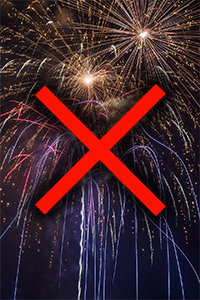
Next week, we celebrate our 250th anniversary of independence from Great Britain. A few weeks ago, we celebrated Memorial Day, where we honored men and women who had made the ultimate sacrifice. I’m as patriotic as the next guy, but over the years, I have come to dread these holidays, and I can explain my disdain in one word: Fireworks.
Despite what we see in old movies, war is not glamorous. It is not glorious, and it is almost never necessary. And so, there’s a morbid kind of irony about the fact that we honor those who died in war by firing off a barrage of mortars and rockets designed to recreate the violent sounds of war.
In my neck of the woods, fireworks are shot off by neighbors in their backyards, and by so-called professionals who are hired by local government to punctuate community gatherings. During a previous Independence Day fete, the combination of private and municipal rocket fire caused the windows of our house to vibrate, and the constant barrage of Scud-like missile activity also caused our dogs to shake uncontrollably. Meanwhile, the noise disrupted bed rest at area nursing homes and retirement complexes. Wildlife fled from their limited wooded habitats and ran nervously into on-going traffic, where at least one deer met its doom. These are all too common scenarios across the country and are of particular interest to Chapel Hill-based Noise Free America.
NFA was founded by the late Ted Reuter, and under his guidance, the organization acted as a clearinghouse for noise complaints and as an advocate for a ban on fireworks altogether. I recall an email exchange I had with Ted back in 2014, in which he reminded me that noise wasn’t the only problem resulting from our annual Independence Day fireworks displays. Serious injuries and deaths also occur. That year, those included three small children and an infant who died in a Philadelphia house fire, which had started when a firecracker was thrown onto a sofa on their front porch. And then there was the man from Michigan who lit some fireworks, which then flew back into his chest, killing him. Ted also mentioned another man who blew his arm off while using fireworks. It’s no wonder that Reuter referred to the Fourth of July as a “deadly and very disruptive holiday.”
Disruptive indeed. In 2023, the National Fire Protection Association reported that over 32,000 fires were caused by fireworks. Those included 3,700 structure fires, 849 vehicle fires, and 27,000 outside fires. That year, fireworks caused over $142 million dollars in property damage. Not surprisingly, more fires are reported on the Fourth of July than on any other day of the year, and fireworks account for half of those fires. By the way, at least 15 people died in the aforementioned fires.
Speaking of human suffering and loss, according to a 2024 report by the Consumer Product Safety Commission, hospital emergency departments treated nearly 15,000 people for fireworks-related injuries, including 26% who were children under the age of 15, and 40% who were under the age of 20.
And, as if we didn’t have enough to worry about, there’s also another kind of danger involving fireworks. Beginning in 2017, Forbes reported a rise in people flying their drones in the airspace just above fireworks displays. When rockets collide with drones, the latter can cause the former to detonate off target and can force hazardous debris down onto unsuspecting spectators.
In addition to producing noise and causing fires and injuries, fireworks are also increasingly causing environmental damage. Studies by the EPA show that chemical residue from fireworks is polluting lakes, ponds, and even contaminating groundwater. That, in turn, negatively impacts the health of humans and wildlife alike.
Because of noise, air, and water pollution, commercial as well as consumer fireworks displays should be banned, with the caveat that localities can issue special permits for venues so long as they aren’t near a residential area, don’t border on a body of water, and where qualified technicians use non-hazardous materials. As a reminder, here in North Carolina, it is illegal for private individuals to use fireworks. According to section 14-414 of the State General Statutes, only caps for toy pistols, smoke devices, party poppers, and wire sparklers are exempt from the ban.
Let’s face it, there’s nothing particularly patriotic or even appropriate about shooting off fireworks in celebration of Independence Day, Veterans Day, and Memorial Day. Surely, we don’t need to be bombarded with the sounds of war when pausing to recognize our freedoms or the sacrifices of our veterans. A simple parade, display of American flags, a brass band, and some sparklers are more than adequate to present a safer, quieter commemoration. I just can’t imagine that anyone who died in battle would feel good about the injury, death, and damage caused by fireworks on his behalf. That kind of senseless loss only serves to dishonor those whom we seek to honor.
























Fireworks Not an Appropriate Celebration
Next week, we celebrate our 250th anniversary of independence from Great Britain. A few weeks ago, we celebrated Memorial Day, where we honored men and women who had made the ultimate sacrifice. I’m as patriotic as the next guy, but over the years, I have come to dread these holidays, and I can explain my disdain in one word: Fireworks.
Despite what we see in old movies, war is not glamorous. It is not glorious, and it is almost never necessary. And so, there’s a morbid kind of irony about the fact that we honor those who died in war by firing off a barrage of mortars and rockets designed to recreate the violent sounds of war.
In my neck of the woods, fireworks are shot off by neighbors in their backyards, and by so-called professionals who are hired by local government to punctuate community gatherings. During a previous Independence Day fete, the combination of private and municipal rocket fire caused the windows of our house to vibrate, and the constant barrage of Scud-like missile activity also caused our dogs to shake uncontrollably. Meanwhile, the noise disrupted bed rest at area nursing homes and retirement complexes. Wildlife fled from their limited wooded habitats and ran nervously into on-going traffic, where at least one deer met its doom. These are all too common scenarios across the country and are of particular interest to Chapel Hill-based Noise Free America.
NFA was founded by the late Ted Reuter, and under his guidance, the organization acted as a clearinghouse for noise complaints and as an advocate for a ban on fireworks altogether. I recall an email exchange I had with Ted back in 2014, in which he reminded me that noise wasn’t the only problem resulting from our annual Independence Day fireworks displays. Serious injuries and deaths also occur. That year, those included three small children and an infant who died in a Philadelphia house fire, which had started when a firecracker was thrown onto a sofa on their front porch. And then there was the man from Michigan who lit some fireworks, which then flew back into his chest, killing him. Ted also mentioned another man who blew his arm off while using fireworks. It’s no wonder that Reuter referred to the Fourth of July as a “deadly and very disruptive holiday.”
Disruptive indeed. In 2023, the National Fire Protection Association reported that over 32,000 fires were caused by fireworks. Those included 3,700 structure fires, 849 vehicle fires, and 27,000 outside fires. That year, fireworks caused over $142 million dollars in property damage. Not surprisingly, more fires are reported on the Fourth of July than on any other day of the year, and fireworks account for half of those fires. By the way, at least 15 people died in the aforementioned fires.
Speaking of human suffering and loss, according to a 2024 report by the Consumer Product Safety Commission, hospital emergency departments treated nearly 15,000 people for fireworks-related injuries, including 26% who were children under the age of 15, and 40% who were under the age of 20.
And, as if we didn’t have enough to worry about, there’s also another kind of danger involving fireworks. Beginning in 2017, Forbes reported a rise in people flying their drones in the airspace just above fireworks displays. When rockets collide with drones, the latter can cause the former to detonate off target and can force hazardous debris down onto unsuspecting spectators.
In addition to producing noise and causing fires and injuries, fireworks are also increasingly causing environmental damage. Studies by the EPA show that chemical residue from fireworks is polluting lakes, ponds, and even contaminating groundwater. That, in turn, negatively impacts the health of humans and wildlife alike.
Because of noise, air, and water pollution, commercial as well as consumer fireworks displays should be banned, with the caveat that localities can issue special permits for venues so long as they aren’t near a residential area, don’t border on a body of water, and where qualified technicians use non-hazardous materials. As a reminder, here in North Carolina, it is illegal for private individuals to use fireworks. According to section 14-414 of the State General Statutes, only caps for toy pistols, smoke devices, party poppers, and wire sparklers are exempt from the ban.
Let’s face it, there’s nothing particularly patriotic or even appropriate about shooting off fireworks in celebration of Independence Day, Veterans Day, and Memorial Day. Surely, we don’t need to be bombarded with the sounds of war when pausing to recognize our freedoms or the sacrifices of our veterans. A simple parade, display of American flags, a brass band, and some sparklers are more than adequate to present a safer, quieter commemoration. I just can’t imagine that anyone who died in battle would feel good about the injury, death, and damage caused by fireworks on his behalf. That kind of senseless loss only serves to dishonor those whom we seek to honor.